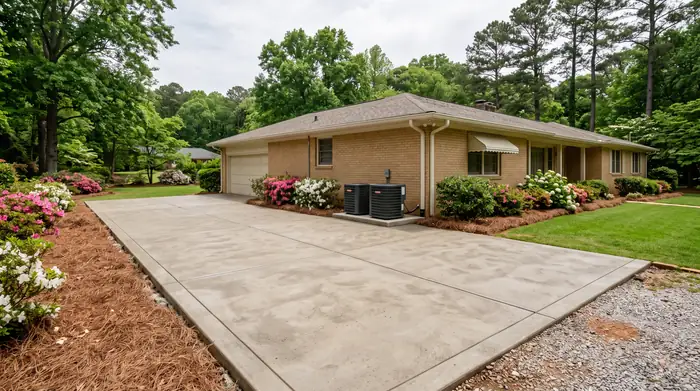
A job starts with a walk of the site. We measure the area, watch where water goes when it rains, and figure out what the old slab was doing before it gave up. Cracking tells one story, settlement tells another, and the repair is different for each. Access matters as much as anything: where the truck can park, how far the chute reaches, whether the mix has to be wheeled in. Everything that comes later is built on that first look.
After the walk you get the scope in writing. Square footage, slab thickness, reinforcement, joint layout, the finish, and how the new pour ties into whatever stays. We would rather answer your questions then than halfway through a pour, when the answer costs somebody a day. If a line in the plan does not make sense to you, say so, and we will either explain why it is there or change it. Most decisions that matter on a concrete installation get made before anyone mixes anything.
Demolition comes first on a replacement. We break out the old slab, load it, haul it off, and protect what stays: irrigation heads, gas service, the lawn edge, the apron next door. Old driveways sometimes hide something underneath. A buried stump, a soft pocket where a trench was backfilled and never compacted, a layer of gravel somebody dumped in twenty years ago. When we find one, you hear about it and about what it changes before we keep going, not after.
Grading is the part nobody sees and everybody feels. We cut the base to the depth the slab needs, compact it, and set the fall so water sheets off instead of standing. Forms go in next, staked and strung to the marked line, then checked for elevation at every stake. A slab is only as flat as the forms holding it, and a bad form line is permanent. Sidewalks show it worst, because people cross them at the same slow pace every single day.
Rebar or wire mesh goes in tied and sitting on chairs, held inside the slab instead of lying on the dirt. Steel on the ground does nothing at all. Pour day runs early. We place, screed and bull float in one continuous pass, because concrete keeps its own schedule and the weather that morning sets the pace for the crew. Everybody has one job and stays on it. Nobody stops for lunch in the middle of a truck.
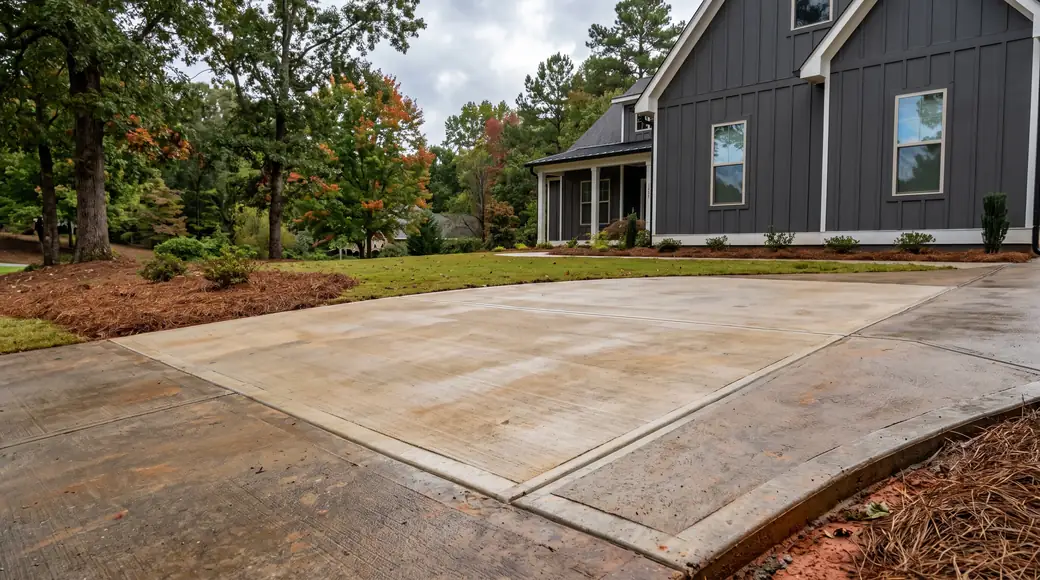
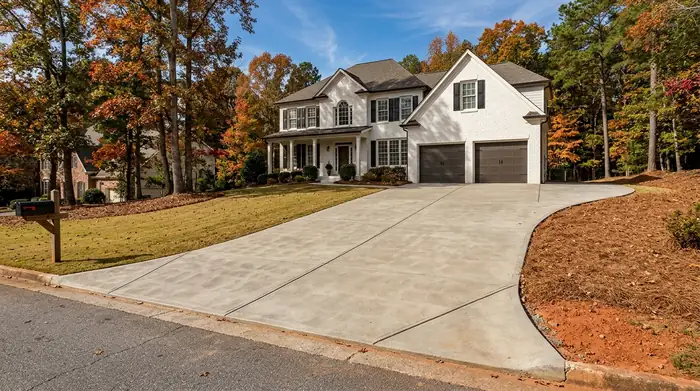
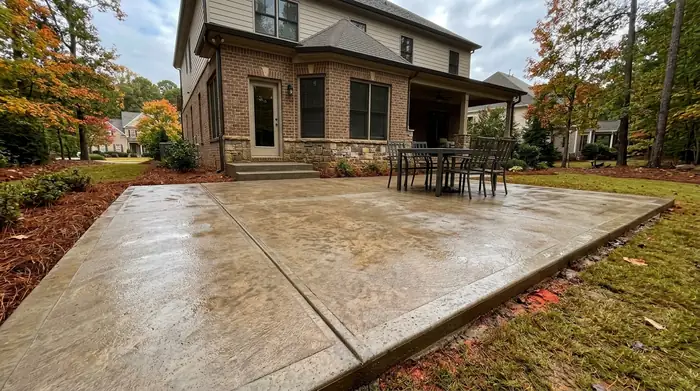
Finish work is where the surface gets its character, and the window for it is narrow. A broom finish is the usual choice on a concrete driveway: it holds traction and it hides wear. Stamped and colored concrete take longer, since the pattern has to be pressed while the slab is still workable and the release has to come off clean. Exposed aggregate gets washed back to bring the stone up. Control joints are cut on a spacing matched to thickness, which is how you choose where cracks go.
Curing is waiting, and the waiting is part of the work. Foot traffic can go on well before a vehicle can, and parking on green concrete is the quickest way to ruin a good pour. You get the dates in plain language before we leave. Nearly every failure we are called to look at traces back to something skipped in the first two days: no compaction, no steel, joints cut late or never cut. None of it shows on day one.
We work Marietta and the rest of metro Atlanta, including Atlanta, Smyrna, Kennesaw and Roswell, on the same terms everywhere. Commercial jobs around Marietta Square, where retail and restaurant frontage runs right up to the walk, get staged around business hours so no doorway sits closed longer than the pour requires. Along the commuter corridors that run toward Atlanta we keep lanes open and equipment tight to the curb. Call for a free estimate.