+1 470-666-7021
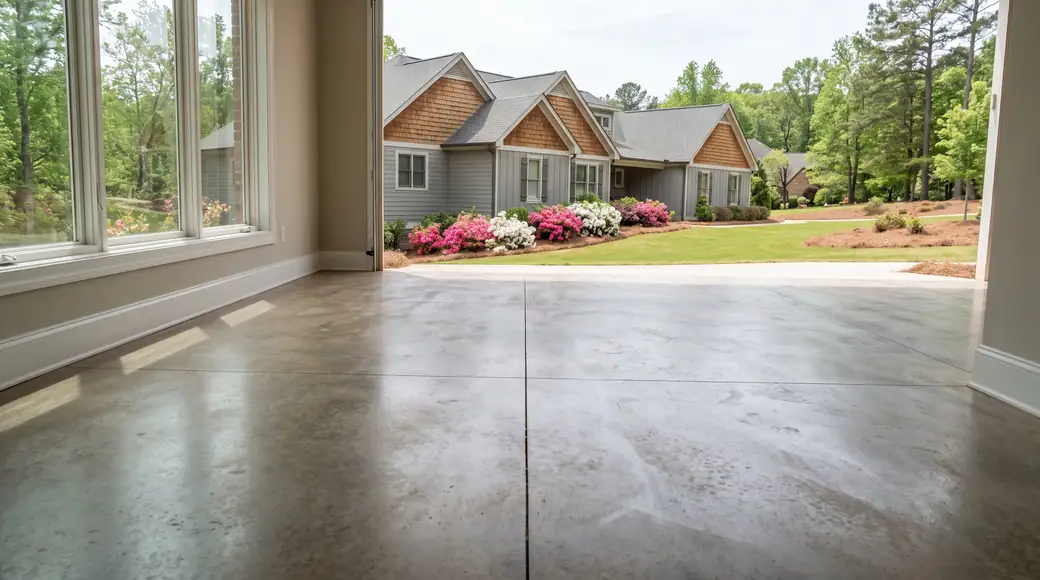
Polished concrete floor with a satin sheen in a finished interior room at a grey split-level home in Marietta, GA, under bright midday cloud.

Polished Concrete Floors in Marietta, GA

A polished concrete floor is the slab already under your feet, ground through progressively finer grits until the surface reflects light on its own. No coating sits on top of it. Nothing peels off in a few years. What you end up with is the concrete itself, hardened chemically and honed to whatever sheen you pick, from a soft satin to something close to a mirror. Character comes from the aggregate the grinder exposes and from dye worked into the surface. Every floor reads a little differently, because every slab was poured a little differently.

Most of the schedule goes to the first two or three passes, where the machines cut past the surface paste and settle on a depth of exposure. After that it is repetition: finer grits, a densifier soaked in and burnished, then the polishing passes that build gloss. We run dust extraction the entire time. That means a floor can be polished inside an occupied building without shutting down the rooms around it, and the space is walkable soon after the last pass.

Trouble usually comes from what is already in the slab. Old patches, mastic left behind by removed tile, cracks that kept moving after the pour, or a surface troweled so tight the grinder wants to skate across it. Some of that we can read before a machine touches anything. Some of it only appears once the first pass takes the top off, which is why we grind a test area and look at it with you before anyone commits to a finish. Early honesty beats a surprise at the end.

Cutting the passes short is where polished floors go bad. Skip grits and you leave scratches that the gloss magnifies instead of hiding. Rush the densifier and it never fully reacts, so the shine goes flat in the traffic lanes while the edges still look new. We would rather move a start date than compress the sequence. A floor done properly gets swept, damp mopped and otherwise left alone for years, which is most of the reason people choose it over anything that has to be stripped and recoated.

Our work covers Marietta and the metro Atlanta towns around it, Kennesaw included, in houses, shops and offices alike. Around Marietta Square, the historic downtown core is ringed with retail and restaurant frontage, the kind of space where a floor takes steady daily use, and the commuter corridors running toward Atlanta keep that traffic moving through. Polished floors are one part of what we do as a concrete contractor. We also pour driveways, handle sidewalk installation, and lay stamped concrete for patios. Call for a free estimate.
Call +1 470-666-7021

Licensed, Bonded, and Insured ยท A combined 15 years of experience

Get Free Estimates

We warranty all of our work because we believe in what we do.

Our Polished Concrete Floors Work in Marietta

Polished concrete

Polished concrete starts with the slab you already have. We grind it flat with progressively finer diamond tooling, fill pinholes and cracks, then densify the surface so it hardens against traffic and stops dusting. The finish depends on how much cream we cut through: a light grind keeps a smooth look, a deeper pass exposes sand or full aggregate. Old slabs hide surprises. Patches, adhesive from tile, and curled joints all show up under grinding, so we look at the floor before quoting a gloss level.

What to Expect on a Polished Concrete Floors Job

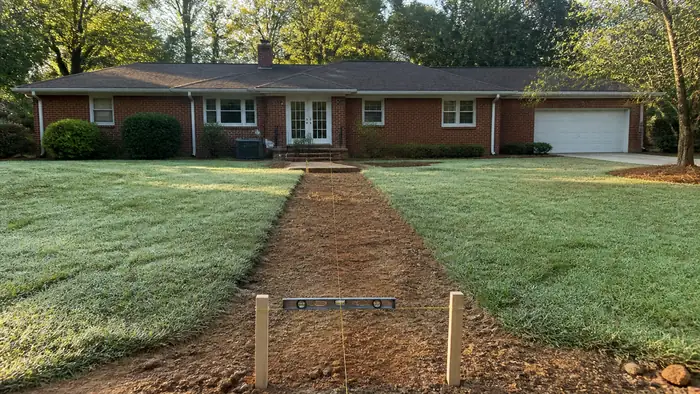
Backyard grade checked with a level and string before a patio pour at a red-brick ranch home in Marietta, GA, in early morning light.

Step 1: Site Evaluation

We walk the space, measure it, then look at what sits under and around it: slope, drainage, where water leaves, and whether a truck can reach the pour. On older Marietta houses the existing slab tells us most of what we need, because cracking patterns show where the base gave up. We note thickness, joint spacing and any settlement, and we talk through what the finished surface has to handle day to day.

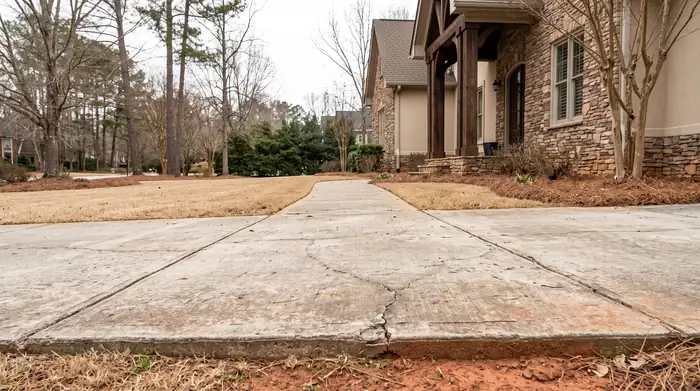
Concrete driveway and walk at a home, the kind of job an estimate covers at a stacked-stone and stucco home in Marietta, GA, under an overcast sky.

Step 2: Written Estimate and Permits

Everything we discussed goes on paper: dimensions, thickness, reinforcement, finish, and the order the work happens in. You have that in writing before anyone starts. Permits for concrete work inside city limits go through the City of Marietta, and we file them and meet the inspections that come with them. If the scope shifts once the old surface is out and we can see the base, that change goes in writing too.

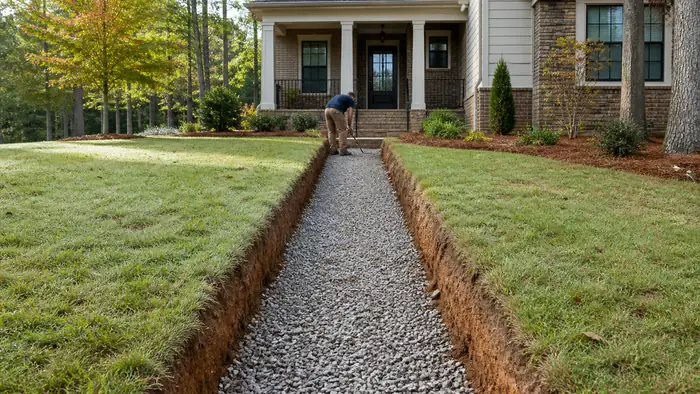
Front walkway removed and the trench squared out for a new pour at a brick-and-siding two-story home in Marietta, GA, in early morning light.

Step 3: Demolition and Base Prep

Old concrete comes out full depth and gets hauled off, not buried along the fence line. We cut the base to grade, dig out soft spots, and compact in lifts until the surface stops taking a boot print. Most failed driveways and sidewalks we replace failed here rather than in the mix. Base work is the least interesting day on the job and the one that decides whether the slab stays flat.

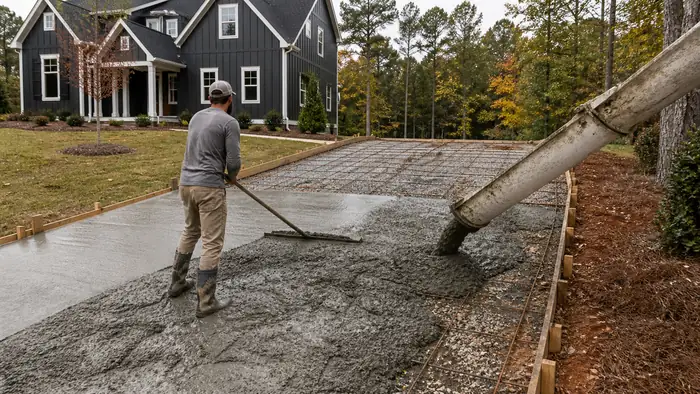
Concrete coming down the chute into formed driveway bays at a charcoal farmhouse-modern home in Marietta, GA, under an overcast sky.

Step 4: Forming, Steel and the Pour

Forms go in on string lines so water runs where you want it, away from the house and toward the street. Rebar or wire mesh sits on chairs in the middle of the slab, not laid on dirt and hooked up afterward. A concrete driveway carrying vehicles gets heavier steel and thickened edges. We place, screed and consolidate in a single continuous pour, so no cold joint runs through the middle of the finished surface.

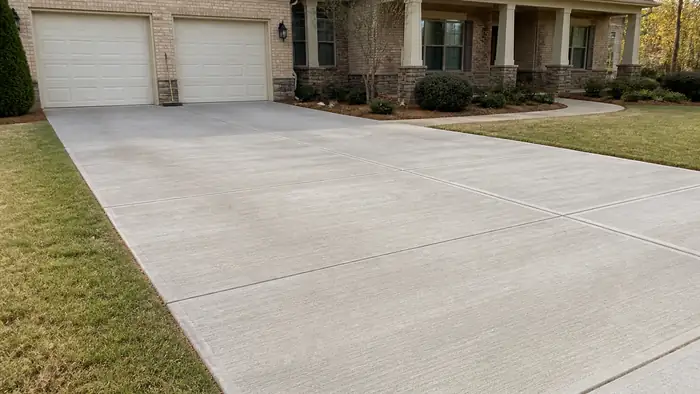
Cured driveway swept clean with the forms stripped away at a brick-and-siding two-story home in Marietta, GA, under bright midday cloud.

Step 5: Finishing, Curing and Final Walkthrough

Timing runs the last few hours. We bull float, edge, and then finish to what the job calls for: broom texture for grip, stamped and colored for patios, exposed aggregate where you want something rougher underfoot. Control joints are cut early, so the slab cracks along the lines we chose instead of wherever it likes. Curing follows, and we tell you plainly how long to stay off. Then we walk the finished concrete installation together.

How Much Does Polished Concrete Floors Cost in Marietta?

Two floors of the same square footage can land far apart, and most of that gap is settled before a grinder ever touches the surface. The slab you already own does the deciding. Walk it yourself and you can predict most of the estimate: what covers it, how flat it sits, how cleanly our equipment reaches it, and how deep a cut the look you want will take.

What changes the priceWhich wayWhy
A sound, reasonably flat slab with no coating on itcosts lessWe start grinding on day one instead of spending days getting back to bare concrete.
Tile, thinset, carpet glue, mastic or old epoxy on topcosts moreEvery layer has to come off before polishing starts, and adhesive removal is slow, dusty work that eats tooling.
Cracks, control joints and spalled patchescosts moreThese get chased out, filled and cured before the first pass, and a badly cracked slab needs more of it.
A new slab poured for polishing (thickness, rebar or wire mesh)costs moreNew flatwork adds forms, subgrade prep, reinforcement and cure time, though it gives us a slab built for the finish.
How the truck and equipment reach the floorcosts more when tightStairs, narrow doorways, upper floors and occupied retail frontage around Marietta Square mean hand-carrying machines and working around a business.
How deep the aggregate exposure goescosts more with deeper cutA light cream finish is a short grit sequence. Salt and pepper or full exposed aggregate means cutting further into the slab, which takes more passes.
Moisture in the slab and how the ground drains around itcosts moreWater pushing up through a slab shows in the polish, so wet conditions call for testing and, sometimes, treatment first.
Night or weekend hourscosts moreRestaurants and shops on the commuter corridors running toward Atlanta often cannot close, so the work moves to off hours.

When you set two bids side by side, make sure both are pricing the same floor. Check whether demolition and haul-off are included or written as an allowance that can grow later. Confirm the grit sequence, the level of aggregate exposure and the final sheen, because those three decide how the floor looks and how long it takes. Ask what happens to cracks and joints, whether a densifier is included and how many passes it gets, who moves the furniture, and how dust is contained. A low number usually means something above was left out. Call us for a free estimate and we will walk the slab with you.

Questions About Polished Concrete Floors

How much gloss can a polished Marietta floor take?

It runs from a soft satin sheen to a near mirror finish, and the difference is grit level. We stop at whatever level you want. Lower grits leave a matte surface that hides scuffs and reads quieter underfoot. Higher grits reflect light and make a room feel brighter, though they show dust sooner. Most homeowners land somewhere in the middle. We polish a test area first so you see the finish on your own slab.

Can my existing Marietta slab be polished, or does it need replacing?

Usually yes, it can be polished. Age is not the deciding factor. We look at hardness, how much aggregate sits near the surface, and whether the slab is sound underneath. Older homes here often have slabs that grind up beautifully once the top layer comes off. Replacement comes up when a slab is heaving, badly spalled, or poured over a failed base. We tell you which one you have.

How long does polishing a Marietta floor take?

It depends on square footage, the number of grit passes, and how much patching the slab needs before grinding starts. A single room moves faster than an open plan. Densifier and sealer both need time to take. We give you a schedule for your specific floor before we start, and we tell you which days you need to stay off the surface entirely.

How is a polished Marietta floor maintained day to day?

Dust mop it and damp mop it with a neutral cleaner. That is genuinely the whole routine. Skip anything acidic, including vinegar, since acid etches the polished surface and dulls it in patches. Wipe spills reasonably soon rather than letting them sit. No waxing, no stripping, no annual refinishing. If traffic lanes lose their sheen after years of use, a burnishing pass brings them back.

Does polished concrete show every crack in a Marietta floor?

No, but it does not hide them either. Grinding exposes what is in the slab, and cracks stay visible after filling. We fill them with a matched or contrasting compound depending on what you want the floor to look like. Some clients like the character and ask us to leave the map of it showing. Others want it minimized. We walk the slab with you and mark what will still read.

Is polished concrete practical for a Marietta shop floor?

Yes, particularly for retail and restaurant frontage where the floor takes constant foot traffic and gets cleaned every night. Polished concrete handles carts, chairs and dollies without gouging the way a coating does. The reflectivity cuts lighting load. Around the Square, where the historic downtown core sees steady daily volume, a floor that cleans with a mop and does not need recoating earns its place.

Get a Free Estimate

Get Free Estimates

We warranty all of our work because we believe in what we do.

Tap to call +1 470-666-7021