+1 470-666-7021
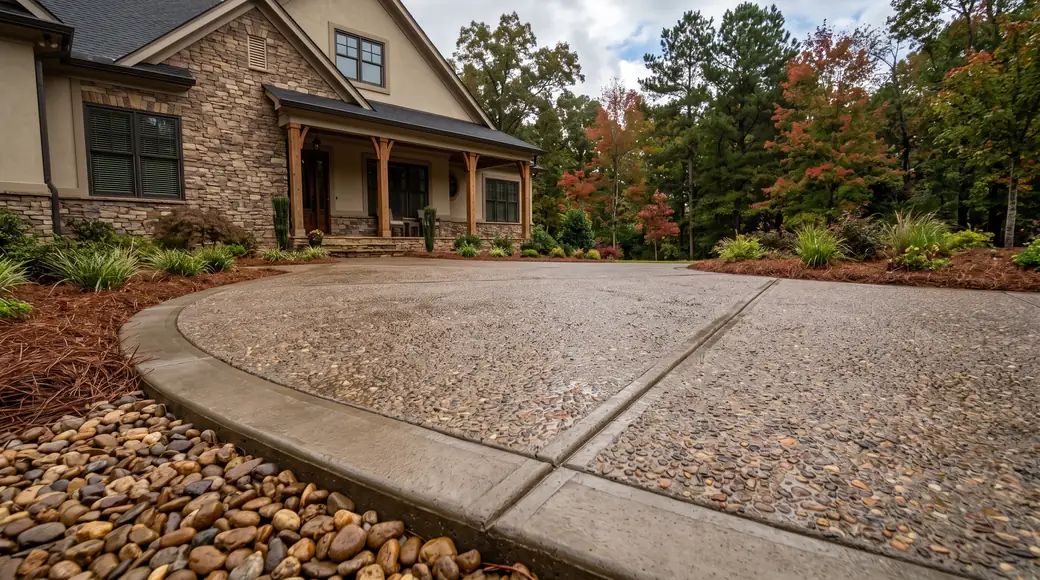
Exposed aggregate concrete driveway showing washed river-rock stone at a stacked-stone and stucco home in Marietta, GA, after a rain shower.

Exposed Aggregate Finishes in Marietta, GA

Exposed aggregate is concrete with the stone left showing at the surface. The rock is already in the mix. We wash and brush away the thin layer of cement paste on top before the slab hardens, and what sits underneath becomes the finish. It has grip underfoot, it hides the scuffs and tire marks a driveway picks up over years, and it does not need a pattern pressed into it to look like something. Around Marietta Square, where retail and restaurant frontage meets the walk, it holds up under steady foot traffic without going slick.

Every job starts with the same three questions: what the slab has to carry, how water leaves it, and which rock you want to see. A concrete contractor who skips that first part pours something that looks right for a season. We form the area, tie rebar or lay wire mesh, place the mix, then wait on the slab and read it. Timing the wash is the whole job. Too early and the stone loosens. Too late and the paste sets hard over the top of it and stays there.

Most of the failures we get called out to look at trace back to that window. A sidewalk washed unevenly shows pale streaks where the paste held and dark ones where it came away, and nothing fixes that afterward except taking the panel out and replacing it. Aggregate left loose sheds stone under traffic. Joints cut late or placed wrong let a slab crack on a line of its own choosing instead of the one we gave it. None of that is exotic. It comes from rushing a surface that will not be rushed.

Getting it right costs attention more than anything else. We choose the aggregate before the pour rather than after, because unlike stamped concrete, which takes its pattern from a tool, this finish can only show what already went into the truck. We pour sample panels you can stand over and look at in daylight. On larger areas we bring enough hands to wash the whole surface in one pass, since a crew that runs out of time halfway across a driveway leaves a seam in the color that never fades out.

Our work covers driveways, patios, walkways and commercial flatwork, new pours and replacement, for houses and for the businesses along the commuter corridors that run toward Atlanta. Most of what we place sits beside concrete somebody else poured years ago, so we spend real time getting a fresh slab to sit right next to what is already there. If you want to see an exposed aggregate finish in person before deciding, we can point you toward finished work. Call for a free estimate and tell us what the space is doing now.
Call +1 470-666-7021

Licensed, Bonded, and Insured ยท A combined 15 years of experience

Get Free Estimates

We warranty all of our work because we believe in what we do.

Our Exposed Aggregate Finishes Work in Marietta

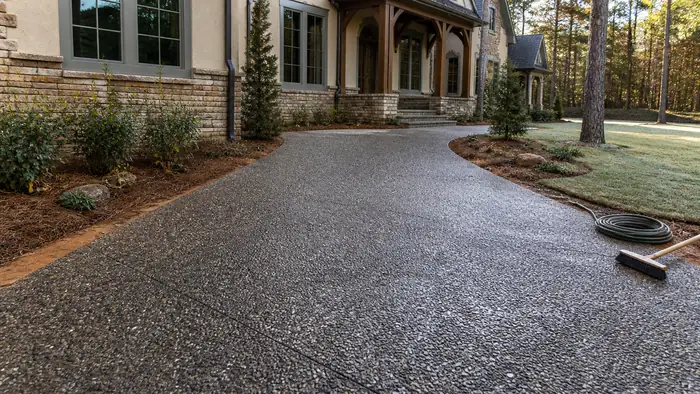
Newly washed exposed aggregate driveway with the stone just revealed at a stacked-stone and stucco home in Marietta, GA, in early morning light.

Exposed aggregate driveway

We pour a four inch slab over compacted base, set rebar or wire mesh, then wash and brush the top to expose the stone. Timing decides the finish: too early and aggregate pops loose, too late and the paste stays. A driveway carries more weight than a concrete sidewalk, so as a concrete contractor we build the base first. Unlike stamped concrete, the texture is real stone. Aprons at the street go through the City of Marietta. Commercial concrete gets a thicker slab and tighter steel.

What to Expect on a Exposed Aggregate Finishes Job

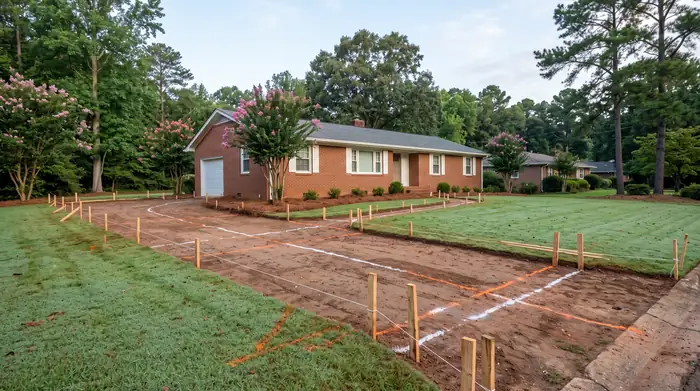
String lines and grade stakes laid out across a yard before a pour at a red-brick ranch home in Marietta, GA, in early morning light.

Step 1: Site Evaluation

We walk the area with you and look at what the concrete has to sit on. Slope, drainage, tree roots, where water goes after a storm, and how close the utilities run. On an exposed aggregate driveway we check the approach grade and how vehicles turn in, since that decides slab thickness and where control joints go. We also look at what stone finish suits the house.

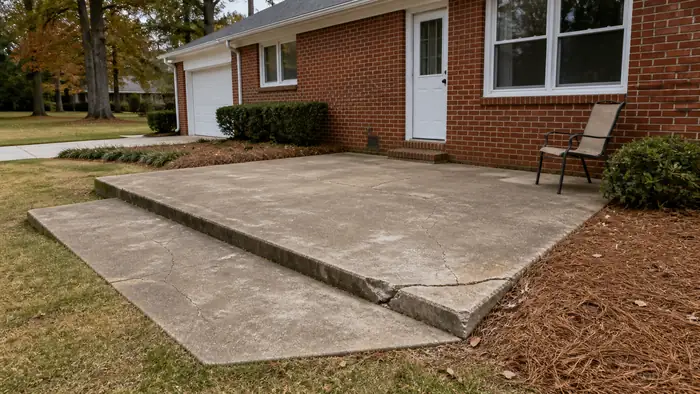
Worn back patio and steps of the kind a written estimate prices at a red-brick ranch home in Marietta, GA, under an overcast sky.

Step 2: Written Estimate and Permits

You get a written estimate that spells out square footage, slab thickness, reinforcement, the aggregate blend, and the joint layout. No line items appear later that were not on the page. Where a job touches the right of way or a sidewalk in front of a home, we pull the permits and handle the inspection scheduling ourselves. Call for a free estimate on any of this.

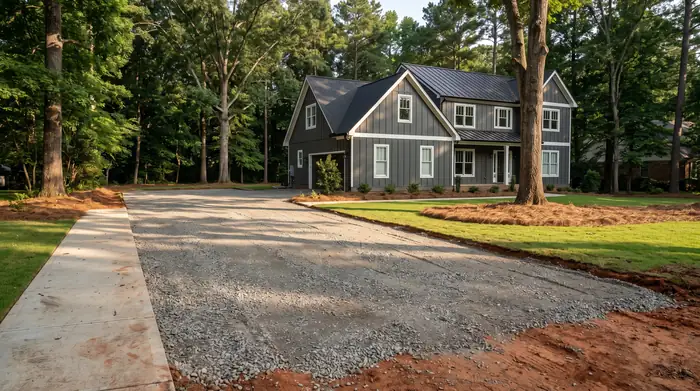
Broken-out concrete removed and the base rebuilt before a new pour at a charcoal farmhouse-modern home in Marietta, GA, in late afternoon light.

Step 3: Demolition and Base Prep

Old concrete comes out and gets hauled off, then we cut the subgrade to depth and compact it. Base is graded crushed stone, usually four inches, run with a plate compactor in lifts rather than dumped and leveled. Skipping this is the reason driveways crack in the first two winters. Soft spots get dug out and replaced, not covered over.

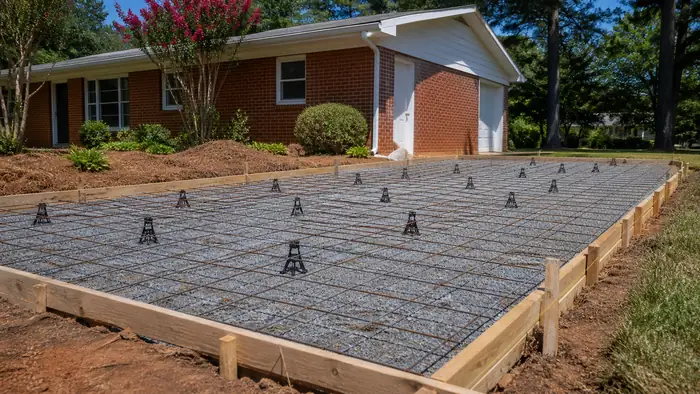
Patio forms squared up with reinforcing mesh on chairs at a red-brick ranch home in Marietta, GA, in clear late-morning sun.

Step 4: Forming, Steel and the Pour

Forms are set to line and grade, staked tight so nothing bellies out under the weight of wet concrete. Steel goes in next: rebar on chairs for driveways, wire mesh pulled up into the slab for sidewalks and patios. Then we place the mix, screed it, and bull float before any bleed water rises. Concrete installation moves fast once the truck arrives.

Control joints cut into a new slab the day after the pour at a buff-brick ranch home in Marietta, GA, under bright midday cloud.

Step 5: Finishing, Curing and Final Walkthrough

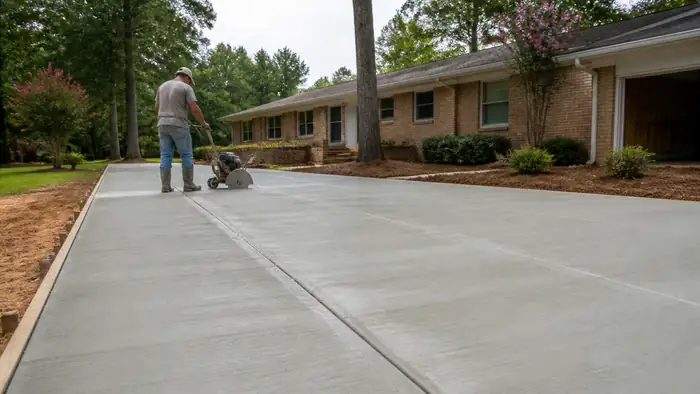
Exposed aggregate gets a surface retarder sprayed on, then we wash and brush the top paste off the next day to bring the stone out evenly. Wash too early and you lose stone; too late and it stays buried. Joints are cut, the slab is cured, and we walk the whole job with you: edges, drainage, stone consistency across driveways and sidewalks.

How Much Does Exposed Aggregate Finishes Cost in Marietta?

Exposed aggregate costs what the site makes it cost. Two driveways of the same square footage can land far apart, and the reasons are usually visible before anyone signs anything. Walk the property before you take bids in Marietta. Most of what follows you can check yourself in ten minutes, and knowing it ahead of time makes every number you read easier to understand.

What changes the priceWhich wayWhy
An old slab already sitting where the new one goesCosts moreIt gets broken out, loaded and hauled off before grading starts. Thick or reinforced concrete takes longer to break than a thin walk.
Bare, roughly level dirt at the work areaCosts lessNothing to remove, so the crew moves straight to grading, base and forms.
How close a mixer can park to the formsCosts less when the truck reaches the pourConcrete off the chute moves fast. Wheelbarrows, buggies or a pump line add labor to every yard that goes in.
Slab thickness the use calls forCosts more as thickness goes upA patio you walk on and a driveway you park a truck on are not the same slab. Thickness drives how much concrete the pour takes.
Rebar mat instead of wire meshCosts moreRebar means more steel, chairs to set it at height, and time to tie the grid. Some flatwork is fine on mesh, some is not.
Trees, roots or stumps within a few feetCosts moreRoots get cut back and the voids get filled and compacted. Skip that and the concrete settles over the soft spot later.
Ground that stays wet or holds water after rainCosts moreSoft subgrade needs stone base and compaction, and the finished surface has to be pitched to carry water off it.
Stone size and how deep we wash the surfaceCosts more with larger stone and deeper exposureA light wash over a standard mix is quick. Specialty aggregate and heavy exposure mean more material and a longer, more careful finishing window.

Compare bids on scope, not on the bottom line. Ask each contractor for slab thickness, reinforcement (mesh or bar, and what size), base depth, control joint spacing, whether demolition and haul-off are included, which aggregate is being used, and whether sealer is in the number. Two quotes that look far apart often describe two different slabs. Get all of it in writing with quantities, and the comparison makes itself.

Questions About Exposed Aggregate Finishes

Is exposed aggregate too rough underfoot around a Marietta pool?

No. The stone stands proud of the surface, but the pebbles we use around pools are rounded and washed rather than crushed, so bare feet read the texture as grip instead of grit. Depth of exposure is ours to control. A light wash leaves the tops of the stone barely showing, which is what we usually run on a pool deck and the walkway feeding it.

How does exposed aggregate wear on a Marietta driveway?

It holds up well, because the wearing surface is stone rather than cement paste, and stone does not scuff or dust the way a troweled slab can. Tires turning in place are the real test. On a concrete driveway we hold the wash back a little so the pebbles stay locked in the matrix, and we set rebar or wire mesh so the slab moves as one piece.

Does exposed aggregate need sealing in Georgia?

Yes, though nothing structural depends on it. Sealer deepens the color of the stone, keeps oil and leaf stains sitting on top instead of soaking in, and binds any loose sand left behind by the wash. Plan on a recoat once water stops beading. Going without does not ruin the concrete. The stone simply reads drier and lighter, and stains take more scrubbing.

How does exposed aggregate compare on price in Marietta?

Exposed aggregate lands above a plain broom finish and sits close to stamped concrete, since both ask for real work after the pour. It comes in under hand set stone or pavers over the same area. Comparing bids only tells you something when the stone blend and the depth of exposure match, so ask what each one assumes. Call for a free estimate.

What stone options do you use for exposed aggregate around Marietta?

Most of our work uses rounded river gravel, in tan and brown blends or a grayer mix, with pea gravel where someone wants a finer, more even face. Crushed granite reads sharper and more angular. We can also tint the surrounding concrete so the matrix around the stone runs warm rather than gray. Same blends for Marietta, Smyrna, Kennesaw, Roswell, Atlanta and the rest of metro Atlanta.

Can you expose aggregate on an existing slab in Marietta?

No, not in the true sense. Exposing aggregate happens while the concrete is still green, washing cement paste off the surface to uncover the stone underneath. Once a slab cures, that window has closed. Grinding an old slab reaches different stone and gives you a polished look, not this one. For an existing patio or driveway, the honest options are a topping or a new pour.

Get a Free Estimate

Get Free Estimates

We warranty all of our work because we believe in what we do.

Tap to call +1 470-666-7021