+1 470-666-7021
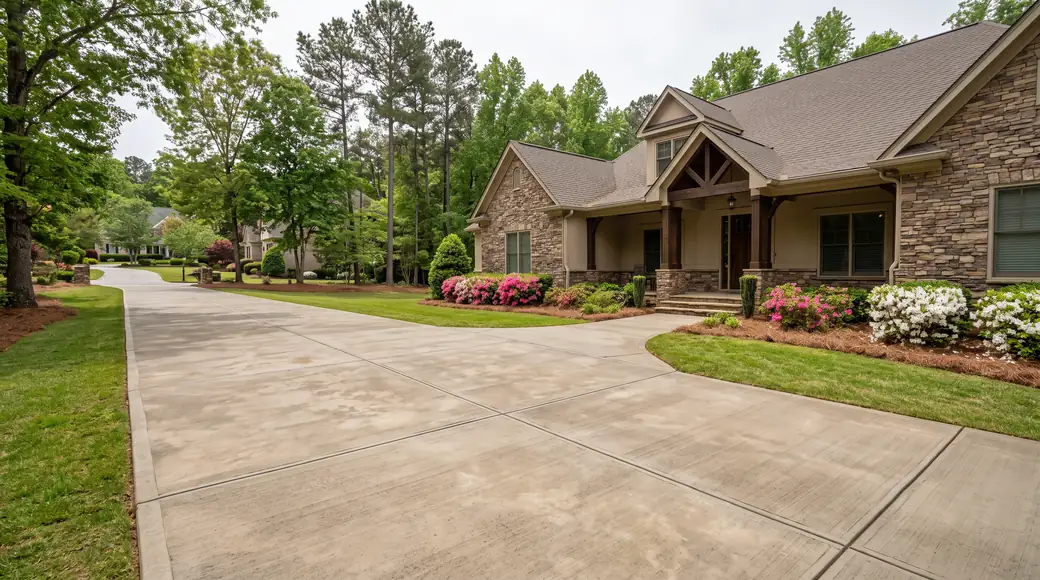
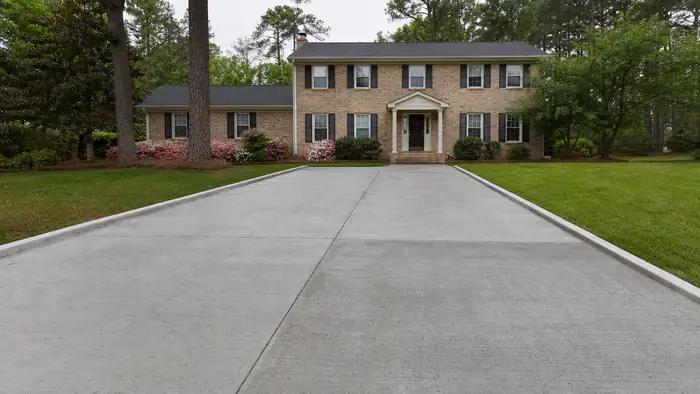
Concrete sidewalk and parking-lot island paving at a retail center in Marietta, GA, under an overcast sky.

Commercial Concrete for Retail & Shopping Centers in Marietta, GA

We are a concrete contractor working on retail and shopping center property in Marietta, Georgia. Storefront walks, parking bays, loading aprons, trash enclosure pads, the ramp at the door. Most of it is flatwork people cross all day without thinking about it, which is the point. When the concrete at a shopping center starts breaking up, customers notice the trip edge in the walk before they notice anything else about the property. That is the work. We keep it in the condition a tenant can live with.

Around Marietta Square, the historic downtown core, retail and restaurant frontage sits right on the sidewalk, and the concrete underfoot works from open to close. Farther out, the commuter corridors running toward Atlanta feed centers whose parking and entry walks take their heaviest load twice a day. Different sites, one requirement. A concrete sidewalk in front of a leased space has to stay flat, drain where it is supposed to, and stay usable while the store is open. We plan around that.

Plain gray flatwork, exposed aggregate, colored and stamped concrete: we pour all of it, and the choice usually comes down to what the frontage is meant to look like. Stamped concrete gets the same base underneath as anything else, meaning compacted subgrade, rebar or wire mesh sized to the load, and joints cut where the slab wants to crack anyway. What sits on top is a decision about appearance. What sits underneath is not a decision at all. Call for a free estimate, whether the job is one panel of sidewalk out front or the full lot behind the building.

Call +1 470-666-7021

Licensed, Bonded, and Insured ยท A combined 15 years of experience

Get Free Estimates

We warranty all of our work because we believe in what we do.

Our Commercial Concrete for Retail & Shopping Centers Work in Marietta

Commercial concrete on a retail property is the flatwork your customers actually touch: the parking bays they pull into, the walk from the space to the door, the pad the dumpster sits on, the apron a delivery truck crosses twice a week. It carries weight and it carries traffic, all day, in every kind of weather. A concrete contractor working retail is building a surface that has to hold up under load and still look right at the front door.

Load is what separates this from residential work. A house driveway sees a sedan. A shopping center drive sees loaded box trucks, trash trucks with lift arms, and delivery vans turning tight, and centers along the commuter corridors running toward Atlanta take that traffic all day. So the slab goes thicker where the trucks run, the base gets compacted under it, and steel goes in: rebar through the heavy sections, wire mesh through the lighter flatwork.

Sidewalk work along a storefront row has its own rules. The new pour has to meet the existing concrete sidewalk at both ends without a lip, hold enough fall to move water away from the glass and the door thresholds, and stay walkable for a stroller or a wheelchair. Where a walk meets a curb, the ramp and the landing come out of the same pour. Poured on grade, a sidewalk lasts decades. Poured off grade, it holds puddles.

Appearance counts for more on retail frontage than most people expect. Around Marietta Square, the historic downtown core surrounded by retail and restaurant frontage, a plain gray slab can read as an afterthought. Stamped concrete, integral color and exposed aggregate all give an entry court, a patio or a seating area some texture without costing you durability. What sits under a stamped pour is identical to what sits under a structural one: same base, same steel, same joint spacing.

Most of the failures we get called out to fix trace back to something that happened before the pour. Base was never compacted, so the slab settles and cracks across itself. Joints were spaced too far apart or cut too shallow, so the concrete picked its own line. Water was given nowhere to go, so it stands in a low spot right where people walk. Concrete is unforgiving of whatever was skipped underneath it.

Coverage runs across metro Atlanta, and every town on that list gets the same crew and the same standard: Marietta, Georgia, along with Atlanta, Smyrna, Kennesaw and Roswell. Retail sites in all of them share one condition, which is that the work happens on a property that still has customers crossing it while the truck is on site. That is ordinary for us, and we build the pour around it. Call for a free estimate on commercial concrete.

What to Expect on a Commercial Concrete for Retail & Shopping Centers Job

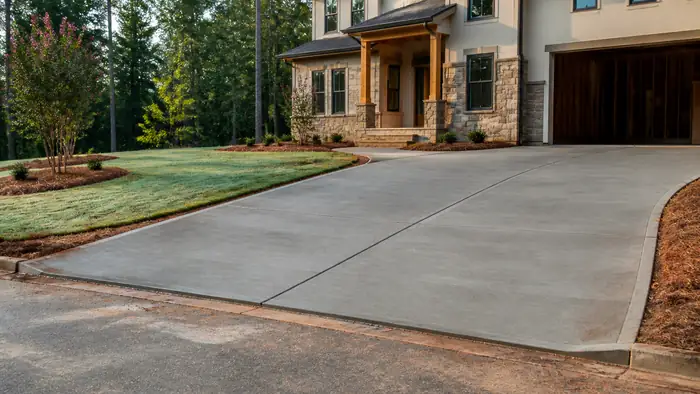
Entrance walkway checked for trip hazards at a business door in Marietta, GA, in late afternoon light.

Step 1: Site Evaluation

We walk the property with you and look at what is already there: existing slab condition, cracking patterns, how water moves across the lot, and where trucks and foot traffic actually go. Retail frontage adds parking counts, entry doors and loading areas to the list. We measure, note elevations, and check what the base under the old concrete looks like. That evaluation is what makes the rest of the numbers honest.

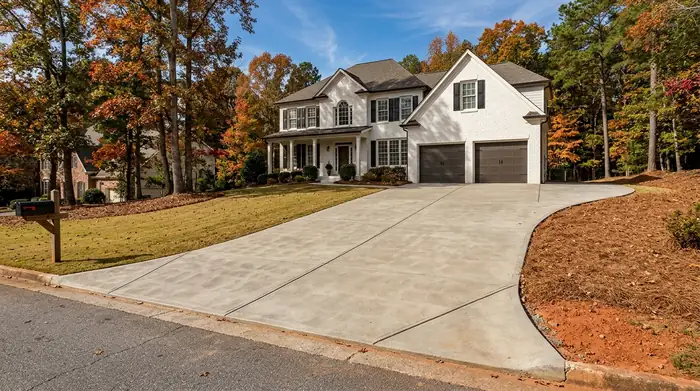
Service yard slab assessed where heavy vehicles have broken it up in Marietta, GA, in early morning light.

Step 2: Written Estimate and Permits

You get the scope in writing: square footage, slab thickness, reinforcement, finish, jointing plan and how the site gets staged. Written detail matters most on retail work, where a shopping center cannot lose its whole parking field at once. Paperwork gets filed before mobilization. We handle that side, and we tell you plainly what the approval process means for your start date.

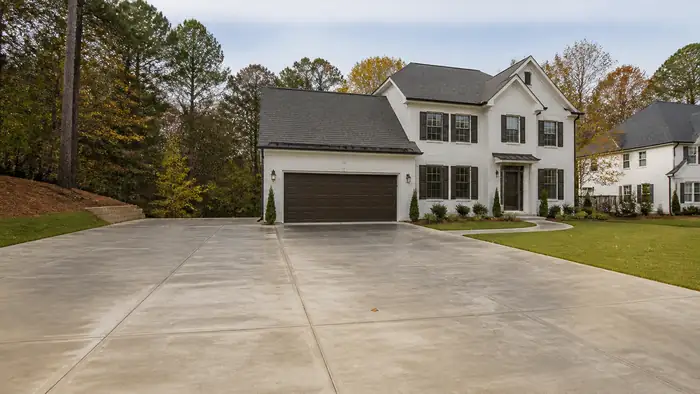
Section of parking lot saw-cut out with the base regraded in Marietta, GA, under bright midday cloud.

Step 3: Demolition and Base Prep

Old concrete comes out and gets hauled off, not buried on site. Then we get to the part that decides whether the slab lasts: the base. Graded aggregate, compacted in lifts, tested for consistency across the whole pad. Soft spots get dug out and rebuilt. Most failed concrete installation traces back to skipped compaction rather than bad mix, and no amount of steel makes up for a base that moves.

Heavy dock slab formed with a doubled rebar mat before the pour in Marietta, GA, in clear late-morning sun.

Step 4: Forming, Steel and the Pour

Forms go in on string line so slopes actually drain and sidewalks meet doors at the right height. Reinforcement depends on load: wire mesh for light pedestrian flatwork, rebar on grid for a concrete driveway, drive aisles or dumpster pads. Steel gets chaired up into the slab, not laid on the ground. On pour day we place, screed and let the concrete take its set before anyone touches the surface.

New parking concrete cured and freshly striped into bays in Marietta, GA, in late afternoon light.

Step 5: Finishing, Curing and Final Walkthrough

Finish comes down to use. Broom texture for sidewalks that get wet, exposed aggregate or stamped and colored work where the storefront calls for it, hard trowel inside. Control joints get cut early, at the right depth and spacing, so cracks land where we put them. Curing gets protected, and driveways stay closed until the concrete is ready for traffic. We walk it with you at the end.

How Much Does Commercial Concrete for Retail & Shopping Centers Cost in Marietta?

Most of what moves a bid up or down is visible before anyone pours. Walk the lot and look at what we look at: what the old slab sits on, where a mixer can park, how water leaves the pavement. All of it is checkable on foot.

What changes the priceWhich wayWhy
Old slab or asphalt already in placeCosts moreIt has to come out and get hauled off before any new flatwork starts.
Distance from truck to pourCosts more when longA mixer that cannot reach the forms means a pump, buggies or wheelbarrows, and added labor hours.
Slab thickness the use calls forCosts more when thickA pad that takes delivery trucks and dumpsters carries far more concrete than a walkway.
Rebar instead of wire meshCosts moreA mat tied on chairs is more steel and more time on your knees than rolled mesh.
Condition of the baseCosts less when soundCompacted stone that drains can stay. Soft or pumping subgrade gets dug out and replaced.
Where water goes at the edgesCosts more when it pondsFixing slope, setting a drain or tying into existing structure is work on top of the concrete.
Stamped, colored or exposed aggregate finishCosts more than broomRelease, sealer and a short finishing window add hands to the same slab.
Permitting through the City of MariettaVaries with scopeReview and inspection take time, and that time sits inside the schedule.

Compare bids line by line: thickness, reinforcement and its spacing, base depth, whether demolition and haul off are included, joint layout, sealer. A low number usually means one of those is thinner or missing.

Questions About Commercial Concrete for Retail & Shopping Centers

Can you pour a retail entrance without closing the shop in Marietta?

Yes. We split the entrance and pour half at a time, so there is always a clear path from the parking to the door. Temporary ramping goes in over the joint while the new slab cures. Doors stay usable, deliveries keep coming through the back, and we work the tenant's slow hours wherever the schedule allows it.

Do you take on multi-site retail work across metro Atlanta?

Yes. Rolling programs across several centers are ordinary work for us: sidewalk replacement at one property, dumpster pads at another, an entrance apron at a third. One crew moves through the list, one person reports back to you, and the concrete specification stays identical site to site so the finished flatwork matches across all of them.

Do you handle trip hazard and accessibility issues for Marietta retail?

Yes. Lifted panels get ground flat or cut out and replaced, depending on how far the slab has moved and what pushed it. Where an accessible route is involved, we rebuild the landing, the ramp run and the cross slope to spec instead of patching the high spot and waiting for it to come back.

How do you protect Marietta shopfronts and stock while working?

Glass gets covered, thresholds get boarded, and saw water is contained and vacuumed rather than left to run across a storefront. Around the Square, where retail and restaurant frontage sits right at the sidewalk, we keep the work zone tight and hard barricaded. Nothing stages on a neighbor's frontage, and the area is swept before we leave each evening.

How fast can a Marietta car park be back in use after repairs?

It depends on the mix, the weather and how much of the lot came out. We pour in strips so most of the parking stays open throughout, and we barricade only the fresh concrete. Cure time governs when traffic returns, and you get that date before the pour so your signage and cone plan can match it.

Can you work overnight at a metro Atlanta shopping center?

Yes. Night work suits centers where daytime demolition would empty the lot, and it keeps concrete trucks off the commuter corridors running toward Atlanta at their heaviest. We light the work zone, coordinate access and noise limits with center management, and have the barricades pulled and the surface clean before the first tenant opens in the morning.

Get a Free Estimate

Get Free Estimates

We warranty all of our work because we believe in what we do.

Tap to call +1 470-666-7021