+1 470-666-7021
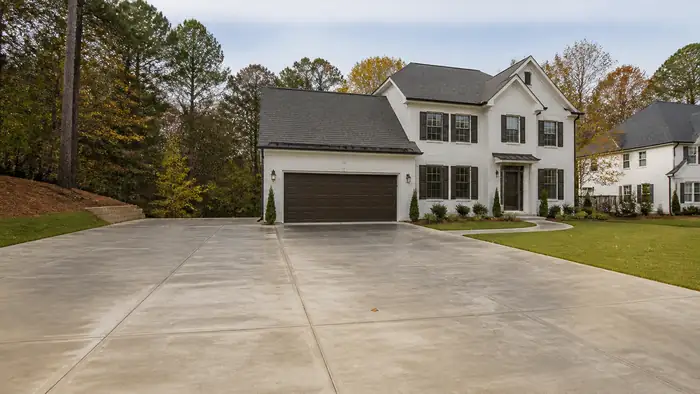
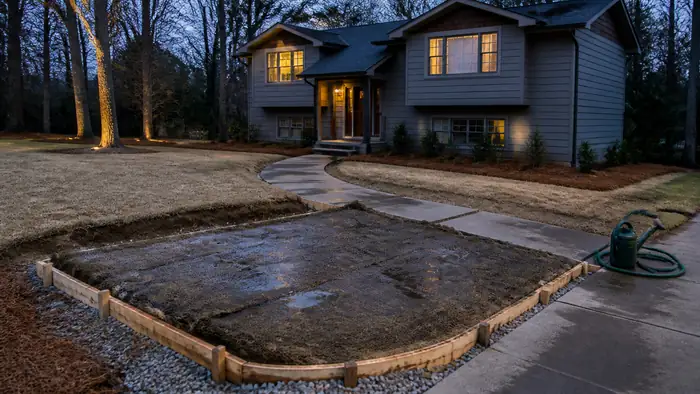
Stamped concrete patio in a running-bond brick pattern at a charcoal farmhouse-modern home in Marietta, GA, under an overcast sky.

Stamped Concrete Patterns in Marietta, GA

Stamped concrete is a slab poured, colored, and pressed with a pattern mat while it is still workable, so the finished surface reads as stone, brick, slate, or wood plank. It is one pour, not a set of units laid piece by piece, which is why a stamped patio or walk holds its line the way a plain concrete slab does. The patterns come in a wide range, from tight running-bond brick to broad ashlar cut stone, and the color is worked in rather than painted on top. We are a concrete contractor, and this is ordinary concrete work done with a decorative finish.

The work happens on a clock. Once the truck discharges, the slab has a working window that closes as the concrete sets up, and every step (screeding, floating, coloring, stamping, detailing the joints) has to land inside it. That timing is the whole job. A crew that is short-handed or slow to move ends up stamping concrete that has gone too stiff, and the impressions come out shallow at the far end of the pour. We size the crew to the pour so the pattern goes in evenly from the first mat to the last.

Failures usually trace back to the part nobody sees. Stamped concrete sits on the same base as any other flatwork, so if the subgrade is soft, the reinforcement is thin, or the control joints are cut in the wrong places, the slab cracks and the pattern goes with it. A crack through a stone pattern is harder to live with than a crack in a plain sidewalk, because the eye follows the pattern lines and the break cuts across them. Compaction, steel, and joint layout matter more here, not less.

Doing it right costs attention more than anything else. Marietta has housing of every age, from the older stock around the Square to newer subdivisions out along the commuter corridors, and a pattern that suits one house looks wrong on the next. We walk the site, look at what the house is made of, and pick a pattern and color that sit with it rather than fight it. Then we handle the rest as a concrete installation first and a decorative finish second: proper base, proper reinforcement, proper joints, clean edges where the patio meets the sidewalk or the drive. Call for a free estimate and we will come look at the space.

Call +1 470-666-7021

Licensed, Bonded, and Insured ยท A combined 15 years of experience

Get Free Estimates

We warranty all of our work because we believe in what we do.

Our Stamped Concrete Patterns Work in Marietta

Stamped concrete

Stamped concrete is a slab with pattern and color pressed into the surface while the mix is still plastic. Timing decides everything. Stamp early and the mats sink and distort the joints, stamp late and the texture stays shallow, then fades under sun. Color comes integrally through the mix or from a release worked into the top. Reinforcement, wire mesh or rebar, goes in first, because a good pattern over a moving slab cracks like any other concrete. That window is short, and it is where a concrete contractor earns the work.

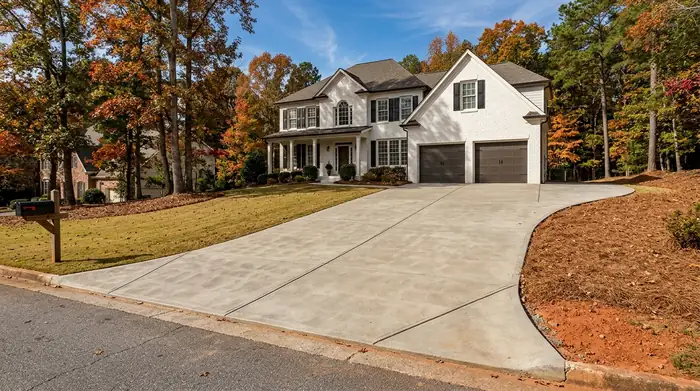
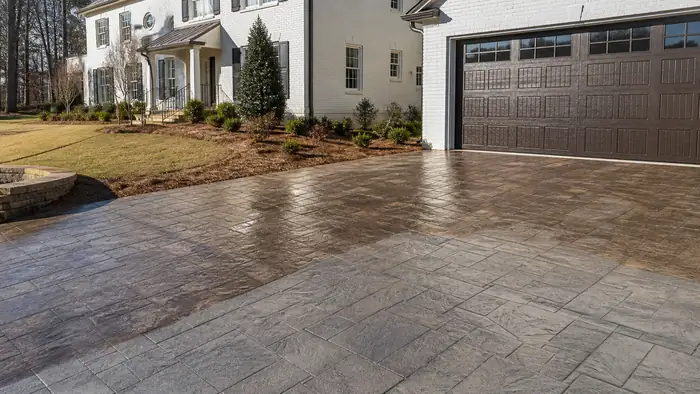
Stamped concrete driveway in a fan-set cobblestone pattern at a tan-brick colonial in Marietta, GA, under an overcast sky.

Stamped concrete driveway

A stamped concrete driveway is built heavier than a patio, since it carries vehicle loads and the scuffing that comes with turning wheels. We set rebar on chairs over a compacted base, and cut control joints so they fall along pattern lines instead of running across them. The apron and the walk crossing are where trouble usually starts. Where a driveway meets a concrete sidewalk with no isolation joint, the two slabs move against each other and the seam opens.

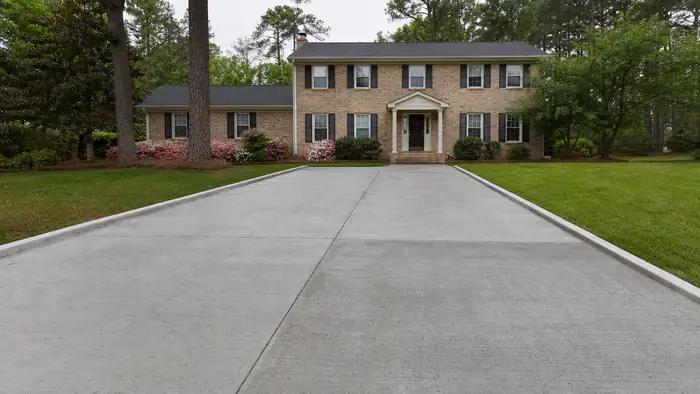
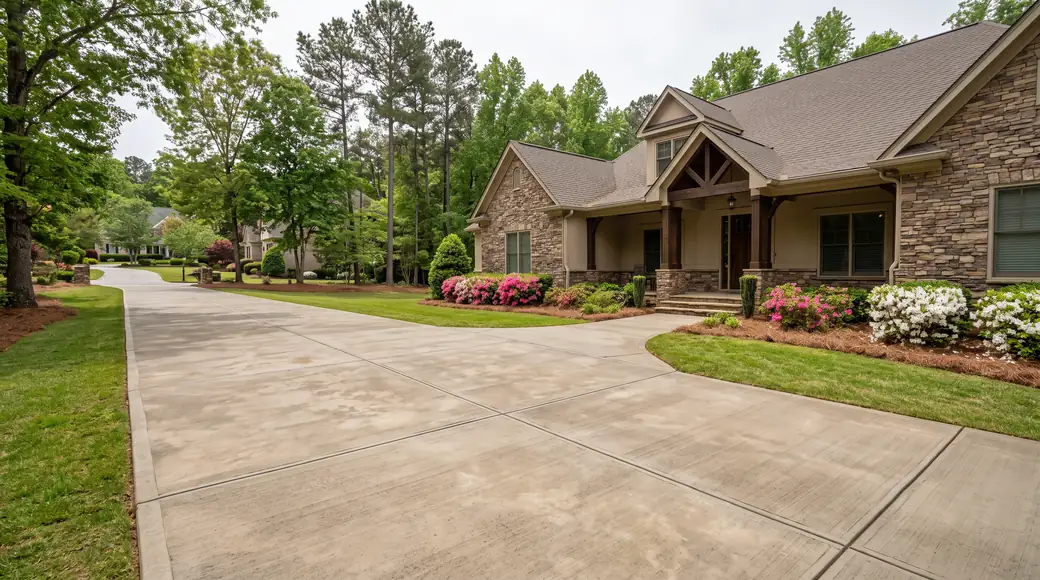
Close-up of stamped concrete texture and hand-tooled joint lines at a buff-brick ranch home in Marietta, GA, after a rain shower.

Stamped concrete patterns

Pattern choice comes down to scale and traffic. Large ashlar slate and seamless skins read quiet across a wide driveway, while running bond brick and cobble suit a patio or a garden walk. Around Marietta Square, with retail and restaurant frontage right at the curb, commercial concrete and sidewalk work tends toward something plainer: broom finish, exposed aggregate, or a light texture that stays walkable wet. Deep relief holds water and grit, so we match the stamp to the use.

What to Expect on a Stamped Concrete Patterns Job

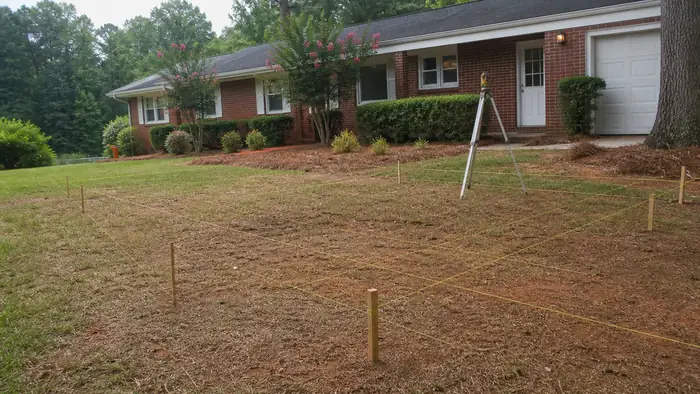
String lines and grade stakes laid out across a yard before a pour at a red-brick ranch home in Marietta, GA, in early morning light.

Step 1: Site Evaluation

We walk the job with you and measure it before anything else. Drainage comes first: where water arrives, where it leaves, where the downspouts dump. We check the existing slab for cracking, settlement and tree roots, and we look at truck access, since a pour is only as good as the truck's reach. On a concrete driveway we look hard at the apron and how the street meets it.

Worn back patio and steps of the kind a written estimate prices at a red-brick ranch home in Marietta, GA, under an overcast sky.

Step 2: Written Estimate and Permits

Your estimate arrives in writing, with the scope spelled out: slab thickness, reinforcement, pattern, color, release, joint layout. Read it before anything gets broken up. Permits for work in Marietta go through the City of Marietta, and we pull them and work around the inspection schedule. A job over in Roswell answers to its own city, handled the same way. Driveway aprons and anything in the right of way carry their own requirements.

Broken-out concrete removed and the base rebuilt before a new pour at a charcoal farmhouse-modern home in Marietta, GA, in late afternoon light.

Step 3: Demolition and Base Prep

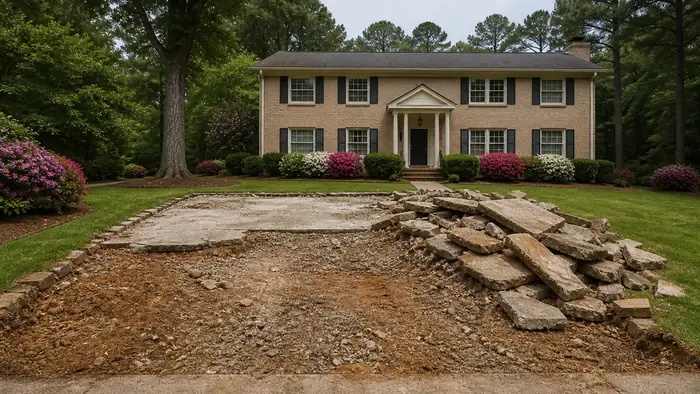
Old concrete comes out and gets hauled off. We do not pour over a failed slab, because whatever cracked the first one is still under there. Subgrade gets graded and compacted in lifts, with crushed stone brought in where the soil is soft or has been disturbed by trenching. Base work is where most flatwork failures start. A slab on loose fill will crack no matter how clean the stamp looks.

Patio forms squared up with reinforcing mesh on chairs at a red-brick ranch home in Marietta, GA, in clear late-morning sun.

Step 4: Forming, Steel and the Pour

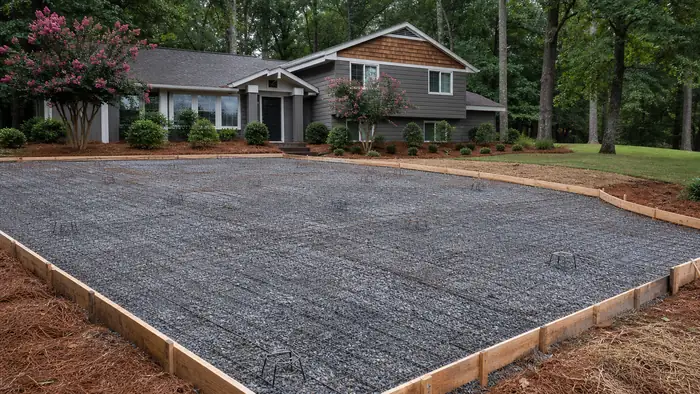
Forms set to line and grade, staked tight so nothing bows out when the concrete hits them. Reinforcement is rebar tied on a grid and chaired up off the base, or wire mesh on lighter flatwork like sidewalks. Thickness follows load, so a patio and a driveway are not poured the same. Concrete installation runs as one continuous pour wherever the layout allows, screeded and floated ahead of the stamp.

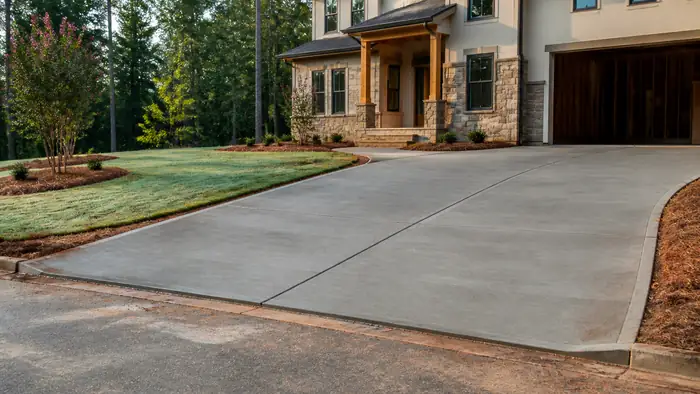
Control joints cut into a new slab the day after the pour at a buff-brick ranch home in Marietta, GA, under bright midday cloud.

Step 5: Finishing, Curing and Final Walkthrough

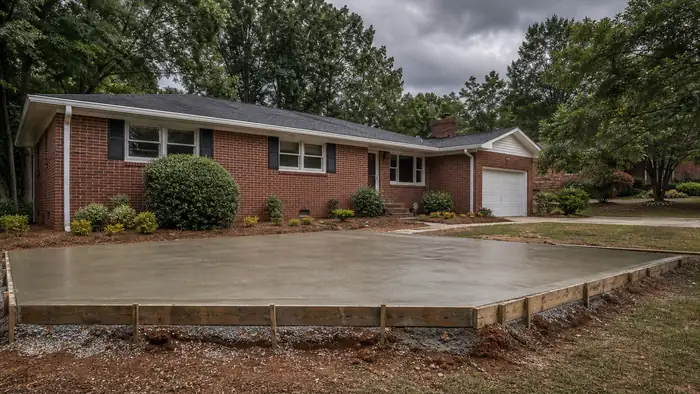
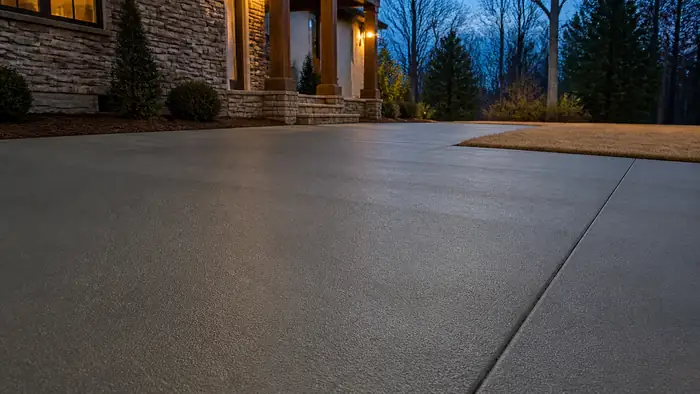
Timing decides everything here. Color and release go down, then we stamp inside the window when the slab will take an impression and still hold it. Too early and it closes up, too late and the pattern is shallow. Control joints get cut so the cracks land where we chose. After curing and sealing, we walk the finished work with you, driveways and patio both, and go over what keeps it looking right.

How Much Does Stamped Concrete Patterns Cost in Marietta?

A stamped patio is priced off the site, not off a catalogue. Two houses on the same street can come in far apart, and the reasons are usually under the surface or out at the curb. Most of what moves the number you can check yourself, standing in the yard, before anyone writes anything down.

What changes the priceWhich wayWhy
An existing slab, pavers or brick where the patio goesCosts moreBreaking out and hauling old concrete is its own stretch of work, and what turns up underneath sometimes changes the base we have to build back.
How a ready-mix truck reaches the formsCosts less when the run is openA truck that chutes straight into the forms saves hours. Older lots around Marietta Square often need every load wheelbarrowed through a side gate instead.
Slab thickness the use calls forCosts more when thickerA patio carrying furniture and foot traffic takes less concrete than a slab you intend to drive on or park a vehicle on.
Rebar rather than wire meshCosts moreRebar gets tied and set on chairs, which takes longer than rolling out mesh. Heavier loads and wider spans are what call for it.
Tree roots and buried lines at the edge of the workCosts moreRoots have to be cut back cleanly and utilities hand dug around, so excavation slows down well before any concrete shows up.
Ground that already falls away from the houseCosts lessWhere the drainage is there, we follow it. Where it is not, we cut slope into the grade and sometimes add drainage, and that is labor and material both.
A grade change between the door and the finished surfaceCosts moreSteps, a raised edge or a retaining course mean more forming, more concrete, and stamping worked around an elevation instead of across flat ground.
Border bands, more than one color, hand toolingCosts moreEach border, release color and hand-detailed edge is a separate pass by hand while the concrete is still open and workable.

Read competing bids line by line instead of bottom line to bottom line. Ask what thickness is being poured, whether the reinforcement is rebar or mesh, how deep the excavation goes, what base material sits under the slab, whether demolition and haul-off are included, and where the control joints land. A bid that leaves those blank is not cheaper. It is just vaguer.

Questions About Stamped Concrete Patterns

What does stamped concrete cost compared with plain in Marietta?

Stamped costs more than a plain broom finish. The pattern work happens after the pour, on a schedule the concrete sets, so it takes more hands and more material: release agent, color hardener, mats, and the sealer that goes on later. Plain flatwork is finished and done. Stamped concrete adds a stage. Another section of this page walks through what moves that number up or down on a given job.

How often does stamped concrete need resealing?

Every couple of years is the usual rhythm, though a driveway that carries daily commuter traffic wears its sealer faster than a back patio that mostly sees foot traffic. Watch the surface rather than the calendar. When the color looks dull and dry instead of deep, and water stops beading, it is time. Resealing is straightforward: clean the slab, let it dry fully, roll or spray the coat on.

How does stamped concrete hold its color in Georgia sun?

Integral color and color hardener hold better than a surface stain, because the pigment goes through the concrete rather than sitting on top of it. Any colored concrete lightens some over years of direct sun. Sealer slows it down and brings the tone back each time it goes on. Earth colors age more gracefully than bright ones, so a slab in full afternoon sun stays looking right longer in a muted palette.

Can you stamp over an existing slab in Marietta?

Yes, with an overlay, if the slab underneath is sound. We check it first: hairline cracks are workable, but a slab that has settled, heaved, or crumbled at the edges will push those problems up through the new surface within a season or two. Older houses here sometimes have driveways poured without rebar or wire mesh, and those are usually better torn out and replaced than covered.

What stamped patterns are popular around Marietta, Georgia?

Ashlar slate and running bond brick come up most. Brick reads well on walkways near the older housing around Marietta Square, where it sits comfortably next to the historic core and the retail frontage. Slate patterns suit patios and pool decks. Large seamless textures work on wide driveways, since the joints of a small pattern get busy across that much surface. Exposed aggregate is another option if you want texture without a stamp.

Is stamped concrete slippery in Marietta rain?

It can be, especially a smooth pattern with a glossy sealer on a slope. We add a fine grit into the sealer coat on steps, pool surrounds, and anything pitched, which gives traction without changing how the surface looks. Deeper textures like slate hold less standing water than flat ones. Tell us where the slab is going and we finish it accordingly.

Get a Free Estimate

Get Free Estimates

We warranty all of our work because we believe in what we do.

Tap to call +1 470-666-7021