+1 470-666-7021
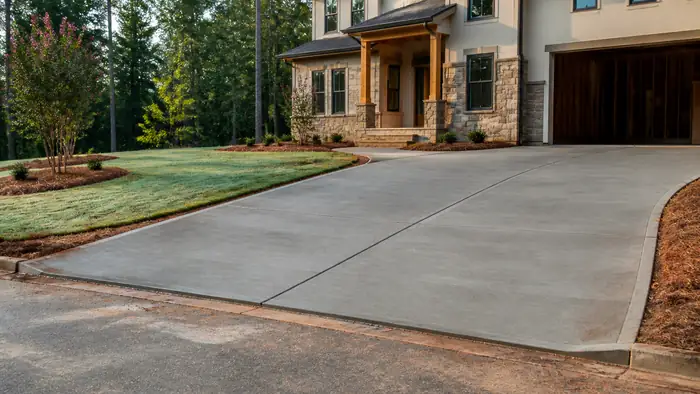
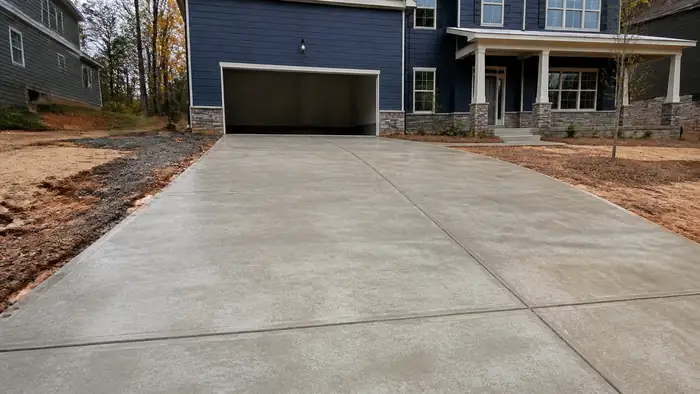
Wide view of finished concrete flatwork across the front of a home at a stacked-stone and stucco home in Marietta, GA, under bright midday cloud.

Marietta Professional Concrete: Residential & Commercial Repair & Resurfacing, Driveways, Patios & Retaining Walls

We pour and repair concrete in Marietta, Georgia, and most of what we do is set by the shape of the town. Around Marietta Square, the historic core sits behind retail and restaurant frontage, where a sidewalk takes foot traffic from open to close and cannot be torn out and left that way. Farther out, the commuter corridors running toward Atlanta feed neighborhoods where the houses went up decades apart and the concrete in front of them was poured on no common schedule. One driveway is original. The next has been replaced twice.

That range is the reason we do not approach every job the same way, and it is the first thing we ask about. Any concrete contractor who pours a patio slab the way they pour a storefront sidewalk will get one of the two wrong, usually the one that matters more. We look at what the slab has to carry, where water goes when it leaves the surface, and what the finish has to sit next to. Stamped concrete beside an older house is a different call than stamped concrete behind a newer one. Call for a free estimate.

Call +1 470-666-7021

Licensed, Bonded, and Insured ยท A combined 15 years of experience

Get Free Estimates

We warranty all of our work because we believe in what we do.

The Concrete Work We Take On in Marietta

We pour driveways, patios, walkways and slabs, and we handle commercial concrete around Marietta Square, where retail and restaurant frontage means a concrete sidewalk takes foot traffic all day and has to sit flat.

Stamped concrete and exposed aggregate go down when a plain gray slab is not the finish someone wants. Any concrete installation starts underneath, though: subgrade, forms, rebar or wire mesh sized to the load.

Business and Multi-Family Concrete in metro Atlanta

Concrete walkway and entry paving at a suburban office building in Marietta, GA, in early morning light.

Offices & Corporate Properties

Entrances, walkways and parking islands take the most abuse on an office site, so we pour them at four inches over compacted stone with wire mesh or fiber. Landings are formed level and given a broom finish for traction in rain. Where a panel has settled and left a trip lip, we saw out the full section rather than patch its edge. Most concrete installation here runs in phases, so one entrance stays open while the other cures.

Concrete sidewalk and parking-lot island paving at a retail center in Marietta, GA, under an overcast sky.

Retail & Shopping Centers

Storefront frontage around Marietta Square carries constant foot traffic, and the sidewalks in front of retail and restaurant spaces show it first: hairline cracking below downspouts, sunken panels where the base washed out underneath. We replace panel by panel, tie clean into the existing curb, and match the finish so the repair does not read as a stripe. Colored concrete and exposed aggregate both hold up well at entries where a plain broom finish would look bare.

Concrete patio slab and service apron behind a restaurant in Marietta, GA, in late afternoon light.

Restaurants & Hospitality

Kitchens push grease, water and loaded carts out the back door all day. Dumpster pads and service aprons get poured thick, eight inches with a rebar mat, jointed to control where cracks land. Out front, patios are built for seating: stamped concrete in a stone or plank pattern, sealed, with slope worked in so runoff moves away from the door. Slabs sunk along a cart path are the repair we see most often.

Concrete loading dock apron and truck pad at a distribution building in Marietta, GA, under bright midday cloud.

Warehouses & Distribution

Truck traffic is the whole design problem here. Dock aprons and turning areas carry loaded trailers, which calls for real subgrade compaction, thicker slabs, rebar on chairs instead of mesh, and joints spaced and filled so forklift wheels do not spall the edges. Interior slab repair we cut and replace in sections. Sites along the commuter corridors running toward Atlanta often need the driveways and approach lanes rebuilt before the yard itself is worth touching.

Concrete entry walk and ADA ramp at a medical office building in Marietta, GA, in clear late-morning sun.

Medical & Dental Offices

Patients arrive on canes, walkers and crutches, so flatwork at a medical or dental office has to be flat in fact and not just in name. We hold drop-off landings and walks to an even slope, keep transitions tight at door thresholds, and finish with a light broom for grip. Where panels have heaved over tree roots, we cut the roots back, rebuild the base and repour instead of grinding the high side down.

Concrete sidewalk network between buildings at an apartment community in Marietta, GA, after a rain shower.

Multi-Family & HOA Properties

Property-wide work needs a schedule more than anything else. A shared concrete driveway serving several units takes far more turning traffic than a single-family one, so it gets poured heavier and jointed tighter. We sequence driveways, unit walks, mailbox pads and dumpster pads so residents keep a way in and out. Sidewalks in older complexes around Marietta and Smyrna fail at the same spots: tree roots, downspout washouts, and the seam where concrete meets asphalt.

Residential Concrete Services in metro Atlanta

Replaced concrete driveway panel with clean saw-cut edges at a charcoal farmhouse-modern home in Marietta, GA, after a rain shower.

Repair, Leveling & Resurfacing

Sunken slabs usually mean the base washed out or was never compacted properly, not that the concrete itself failed. We lift settled sections, fill the voids underneath, and grind down the lips that catch a toe. Resurfacing bonds an overlay over sound concrete that has spalled or crazed, and that overlay can be broomed, stamped or colored. When cracking runs clear through the slab and the reinforcement inside is rusting, replacement is the honest answer, and we say so.

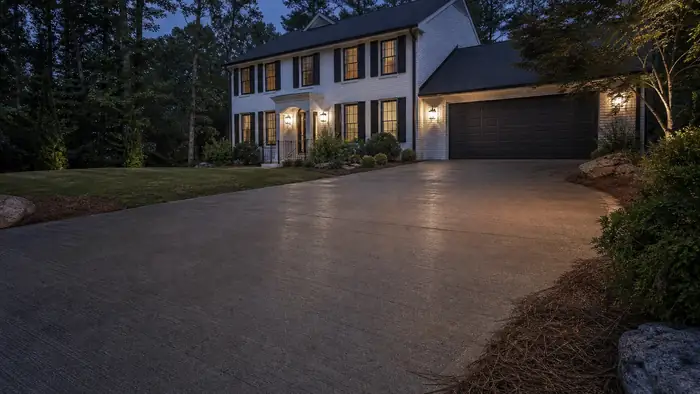
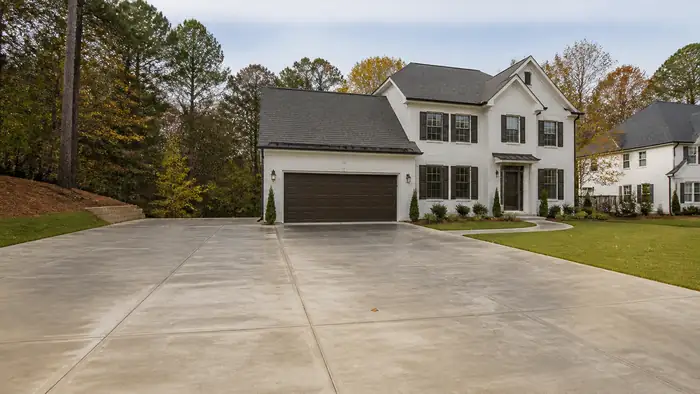
Broom-finished concrete driveway running up to a two-car garage at a painted-white-brick two-story home in Marietta, GA, in clear late-morning sun.

Driveway Installation & Replacement

A driveway carries vehicle loads, so we pour it thicker than a walkway: four inches over compacted base for cars, more where a truck or trailer parks. Wire mesh or rebar sits on chairs so the steel ends up in the middle of the slab instead of lying in the dirt. Control joints go in early and get spaced to the thickness, because concrete cracks and joints decide where. Old driveways often sit on no real base at all.

Rectangular concrete patio with a low step up to the rear door at a brick-and-siding two-story home in Marietta, GA, after a rain shower.

Patio Construction & Outdoor Living

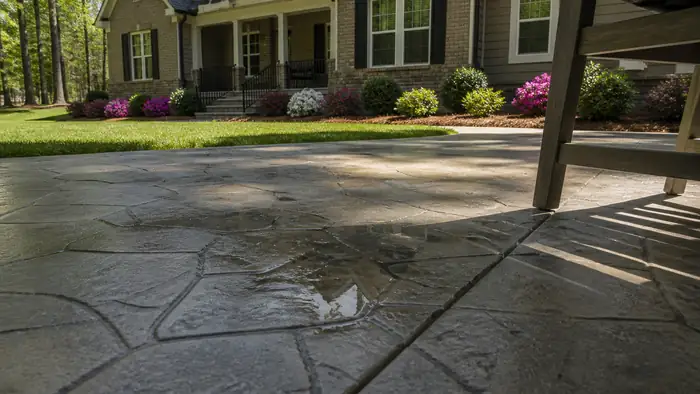
Patios take less load than driveways, so most of the thinking goes into drainage and finish. We slope the surface away from the house, separate the slab from the foundation with an expansion joint, and choose a texture that stays walkable when wet. Stamped concrete reads as stone or plank, exposed aggregate wears well and hides dirt, and colored concrete can be integral or applied on top. Fire pit pads and steps down to grade pour with it.

Board-formed concrete retaining wall holding a raised lawn at a grey split-level home in Marietta, GA, under an overcast sky.

Retaining Wall Construction

Water is what fails a retaining wall, almost never weight alone. Drainage behind the wall matters more than the face does: gravel backfill, filter fabric, and a drain line daylighted somewhere it can actually run. Poured walls get footings below grade with vertical rebar tied into the stem, sized to the height they hold. We build them to take a grade change, terrace a sloped yard, or square up a parking area, and we keep the top line true.

Square-edged concrete slab pad with a storage shed on it at a buff-brick ranch home in Marietta, GA, under bright midday cloud.

Concrete Slabs & Pads

For sheds, garages, hot tubs, generators and equipment, the pad starts the same way: strip the topsoil, compact the base, set forms to a level line. Thickness and reinforcement follow the load, since a hot tub concentrates weight in four spots while a shed floor mainly needs to stay flat and dry. Anchor bolts, sleeves and conduit get set before the pour. Cutting them in afterward weakens the slab and leaves an edge that spalls.

Poured concrete foundation wall and footing for a room addition at a charcoal farmhouse-modern home in Marietta, GA, in clear late-morning sun.

Foundation Pouring & Repair

Footings carry the building, so they go on undisturbed soil at the depth the plans call for, with continuous rebar and proper laps at the corners. On a repair, the first job is finding what moved: a cracked wall, a dropped corner, water standing against the footing. Underpinning, crack injection and rebuilt sections are all concrete work we take on. Cosmetic patching over active movement hides the problem for a season, then it opens back up wider.

Poured concrete front steps rising to a landing at the front door at a buff-brick ranch home in Marietta, GA, after a rain shower.

Steps, Stoops & Landings

Steps get more use than anything else we pour, and inconsistent risers are what trip people. We hold riser height even from bottom to top, pitch the treads slightly so water runs off instead of sitting, and finish with a broom texture for grip. A stoop ties to the house without bonding to it, so seasonal movement does not tear the joint apart. Handrail anchors, cheek walls and a landing deep enough for a storm door get planned first.

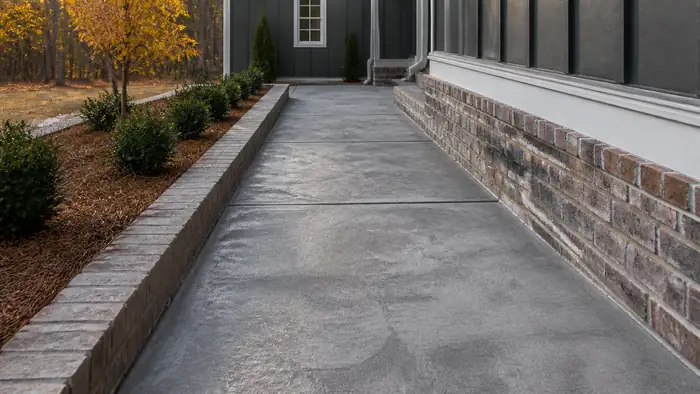
Concrete walkway meeting the driveway apron and front steps at a tan-brick colonial in Marietta, GA, in early morning light.

Walkway & Sidewalk Installation

Sidewalk installation starts with the route people actually walk, not the shortest line on a drawing. A concrete sidewalk runs four inches thick over compacted base, jointed at regular intervals, finished with a broom texture pulled across the direction of travel. Where a walk crosses a drive, the joint is tooled so the two slabs move independently rather than fighting each other. Concrete sidewalk installation at a house usually links the driveway, the front porch and a side gate.

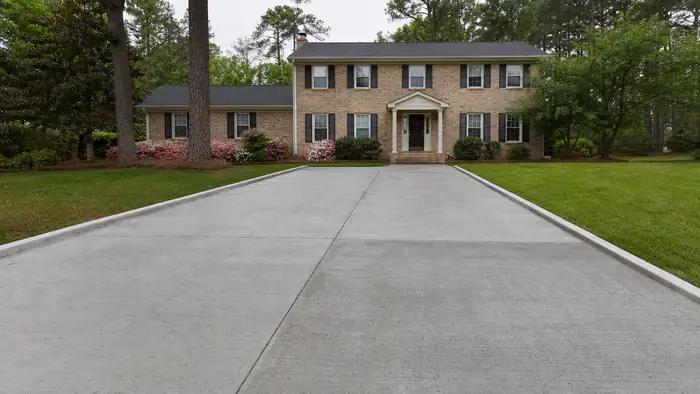
Poured concrete curbing with a rolled profile along a driveway edge at a brick-and-siding two-story home in Marietta, GA, under an overcast sky.

Curbing & Edging

Curbing keeps gravel out of the lawn and gives a mower one clean line to follow. We form and pour continuous curb along beds, drives and islands, with a proper radius where the turns are tight. Edging beside concrete driveways holds the aggregate or asphalt next to it from creeping outward under traffic. Stamped or colored tops are possible on the same pour. Small concrete services like these change how the whole front of a house reads.

Why Choose Marietta Professional Concrete for Your Next Project?

We do concrete work every day, and that repetition shows up in the parts of a pour nobody ever sees. Subgrade compacted properly. Rebar and wire mesh tied and chaired so the steel sits inside the slab instead of resting on dirt. Control joints cut at the right depth and spacing, before the concrete decides on its own where it wants to crack. A driveway that fails in its third year usually fails for one of those reasons, not because of the mix. Marietta has houses of every age, and the flatwork around them was poured under a lot of different standards. We read what is already there before we add to it.

The same crew that sets the forms finishes the surface, so nothing gets lost between one day and the next. Around Marietta Square, retail and restaurant frontage means a sidewalk cannot be closed off and forgotten about, and commuter traffic heading toward Atlanta shapes when trucks can stage. A residential job in Smyrna runs on the same footing, scaled down. We will tell you plainly what a slab needs, what it does not need, and when a repair makes better sense than tearing the whole thing out and starting over. You decide from there. Call for a free estimate and we will come look at the site.

How the Concrete Installation Process Works

Backyard grade checked with a level and string before a patio pour at a red-brick ranch home in Marietta, GA, in early morning light.

Step 1: Site Evaluation

We walk the site with you and measure the actual footprint, because a driveway on paper and a driveway on the ground rarely match. We check the slope, where water currently goes, and whether the existing slab is cracked, settled or simply poured too thin. Access matters as much as anything: a mixer that can back to the pad is one job, and wheeling concrete by buggy is another. Tree roots and utility lines get located now, not after demolition starts.

Concrete driveway and walk at a home, the kind of job an estimate covers at a stacked-stone and stucco home in Marietta, GA, under an overcast sky.

Step 2: Written Estimate and Permits

You get the scope in writing: square footage, slab thickness, whether the steel is rebar tied on chairs or wire mesh, the finish, and where the control joints fall. Nothing important is left to a handshake. Work that ties into a public sidewalk or a right of way usually needs a permit, and that paperwork gets filed and inspections scheduled before anyone breaks ground. Stamped patterns and color selections are settled at this stage, while samples are still easy to compare.

Front walkway removed and the trench squared out for a new pour at a brick-and-siding two-story home in Marietta, GA, in early morning light.

Step 3: Demolition and Base Prep

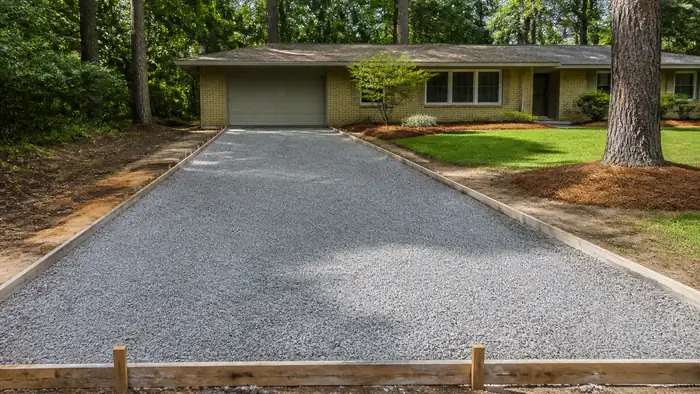
Old concrete comes out and gets hauled off, then the subgrade is cut to the depth the new slab needs. Base stone goes down and is compacted in lifts, not dumped and raked level. Concrete driveways that fail usually fail from underneath, where loose fill was never consolidated and the slab bridged a void until it broke. Grades are set here, so water runs off the pad and away from the house rather than toward it.

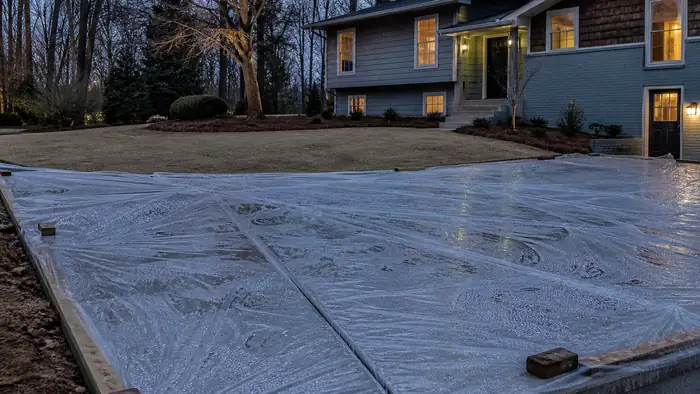
Concrete coming down the chute into formed driveway bays at a charcoal farmhouse-modern home in Marietta, GA, under an overcast sky.

Step 4: Forming, Steel and the Pour

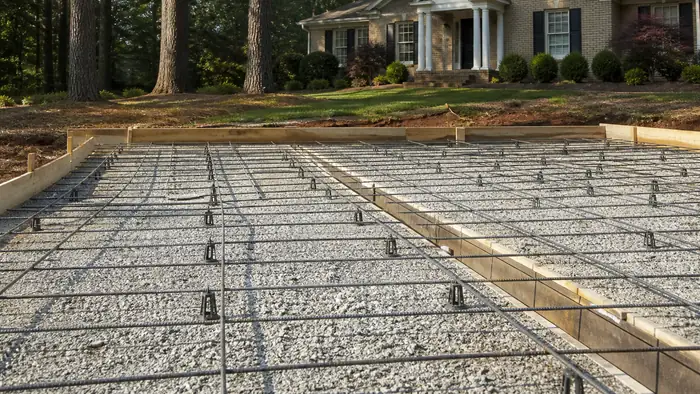
Forms go in on line and grade, staked tight so nothing bows outward when wet concrete pushes against them. Steel sits on chairs, centered in the slab, instead of lying in the dirt doing nothing. We pour continuously, screed, then bull float before the bleed water rises. On the commuter corridors running toward Atlanta, we stage the truck and place early, while the street is quiet enough to work safely. Slab depth increases where vehicles turn.

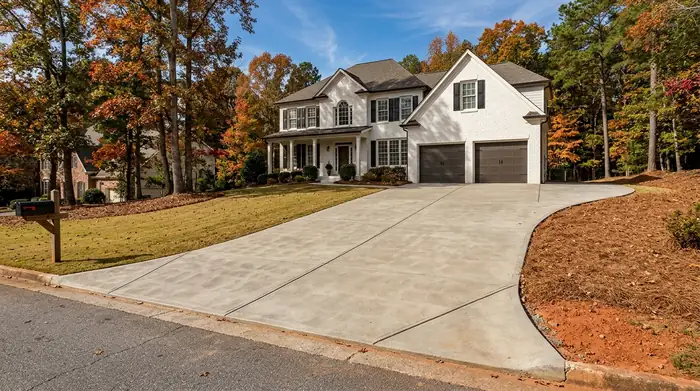
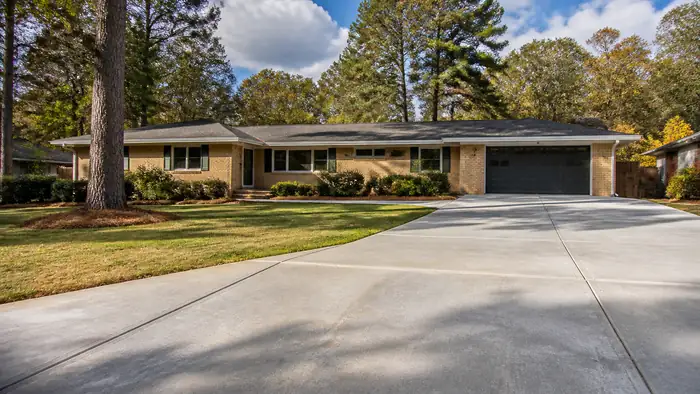
Cured driveway swept clean with the forms stripped away at a brick-and-siding two-story home in Marietta, GA, under bright midday cloud.

Step 5: Finishing, Curing and Final Walkthrough

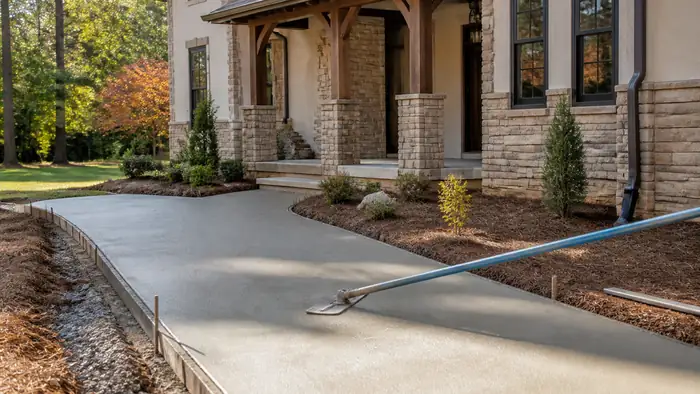
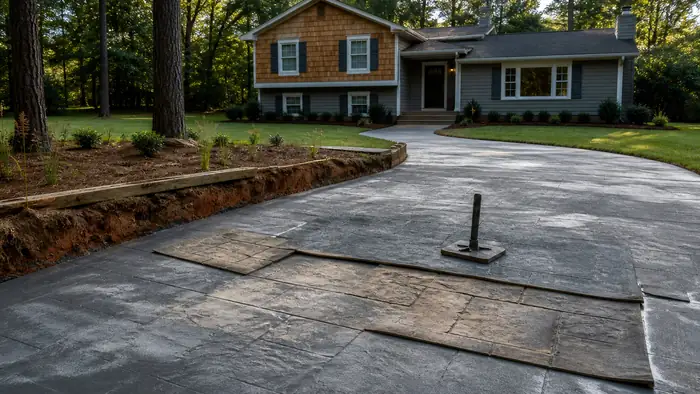
Finish follows the surface. A broom finish gives traction on a sloped drive, stamped mats and color release build texture and pattern into a concrete patio, and exposed aggregate holds up well underfoot. Control joints get cut while the slab is still green, so it cracks along the line we chose instead of wherever it likes. Curing compound goes on, and we walk the finished work with you and say plainly when it takes foot traffic and when it takes a vehicle.

Neighborhoods and Towns We Serve

Most of our work is in Marietta, from the older streets near the Square to subdivisions built decades later. A job in Smyrna runs the same way as one here: same crew, same prep, same mix.

  • Driveways and slab work at houses of any age
  • Stamped and colored concrete for patios, steps and walkways
  • Concrete sidewalk installation along retail and restaurant frontage

Access drives a lot of it. Narrow frontage near the historic core and traffic running toward Atlanta change how we stage a pour, not how we finish it. Call for an estimate and give us the address.

What Concrete Costs in Marietta, GA

Square footage is the smallest part of it. What moves the number on a concrete slab installation is thickness, reinforcement, finish, and how much has to come out before anything goes in. Broom finish takes fewer labor hours than exposed aggregate or stamped work. Tearing out an old slab, hauling the debris off, and grading the base back to spec can run longer than the pour. Access counts too. If the truck cannot reach the forms, the concrete moves by wheelbarrow.

When you have bids in hand, compare these line by line:

  • Slab thickness, written down, not assumed
  • Reinforcement: wire mesh or rebar, and how it is held up off the grade rather than left lying on dirt
  • Subgrade work: what gets excavated, what base material goes back, whether it gets compacted
  • Finish: broom, colored, exposed aggregate, stamped, and whether sealer is included
  • Control joints: where they fall and when they are cut
  • Demolition and haul-off: in the price, or billed after

Two bids on the same driveway often differ because they are quietly describing two different driveways. One is thicker with rebar on chairs; the other is thin with mesh and a fast grade. Both read as concrete on paper. Where a permit is required, that goes through the City of Marietta, and the bid should say who pulls it. A sidewalk at a storefront near Marietta Square also prices differently than the same footage in an open back yard, because the crew works around frontage and foot traffic.

What to Expect When You Ask for a Concrete Quote

We come out and stand on the ground before quoting anything. Photos help. They do not replace that. For a concrete slab installation we measure, check truck access and a wheelbarrow route, and watch where water runs. Grade matters. We ask what finish you want, broom, exposed aggregate, or decorative concrete, since that decision changes the pour and the schedule.

The written estimate lists the parts that actually drive the job: tear-out and haul-off of existing slabs, grading, formwork, reinforcement, the pour, and the finish work. Thickness and reinforcement are stated rather than assumed. Any line on it can be walked through before you decide anything. Call for a free estimate on your Marietta project.

Frequently Asked Questions About Concrete in Marietta

What is the difference between repairing and replacing concrete in Marietta?

Repair makes sense when the slab is still sound underneath and the damage sits at the surface: spalling, a lifted joint, one broken panel in an otherwise flat run. Replacement makes sense when the base has failed, when cracks run the full depth, or when a driveway has settled in several directions at once. We look at what is under the concrete first, then tell you which one the slab actually calls for.

Which towns around Marietta does Marietta Professional Concrete serve?

We work in Marietta and in the towns around it: Smyrna, Kennesaw, Roswell, Atlanta, and addresses across metro Atlanta. Every one of them gets the same crews, the same scheduling and the same build. None of them is a side trip. If your address sits near the edge of that area and you are not sure whether it falls inside, call with the street name and we can sort it out.

How do you protect my lawn and landscaping while you work in Marietta?

Protection gets planned before the truck moves. Plywood and mats go down over turf along the path from the street, plants near the pour get covered or tied back, and washout stays off the grass and out of the beds. Forms, stakes and offcuts leave with us. Where a truck cannot reach the pour without crossing lawn, we say so ahead of the day rather than after.

What does concrete cost per square foot around Marietta, Georgia?

Square footage alone does not settle it. A flat, open pour with a straight truck approach and a plain broom finish is a different job from a tear-out with hand hauling, a thicker slab, added reinforcement and a stamped finish. We measure the site, count the real work in front of us, and put the figure in writing for that specific project. Call for a free estimate.

How do you keep concrete from cracking or settling in Marietta's ground conditions?

Concrete cracks when the ground under it moves, or when the slab has nowhere to relieve its own stress. We address both. The subgrade gets cut to depth, compacted in lifts and checked before any concrete arrives, and we set rebar or wire mesh sized to the slab and how it will be used. Control joints go in early, at the right spacing and depth, so cracks land where we put them.

What decorative finishes can I choose for a project in Marietta?

Stamped concrete covers most of what people ask about: stone, slate, plank and brick patterns, in a range of colors. Past stamped, we pour exposed aggregate, integrally colored concrete, standard gray broom finishes, and saw-cut patterns or borders that frame a plain field. Patios and walkways take decorative work best. A physical sample tells you more than a brochure photo, so ask to see the finish you are weighing.

How far in advance should I book concrete work in Marietta?

Sooner beats later, and the honest answer moves with the season and the weather. Work stacks up when conditions are good, and rain pushes pours that were already on the calendar, which shifts everything behind them. Tear-outs, permits and utility locates all take time before anyone pours a thing. If you are working toward a date, a graduation, a closing, a tenant opening, mention it when you call.

What concrete services do you offer in Marietta, Georgia?

Driveways, sidewalks, patios, slabs, steps, walkways, retaining walls, and repair or resurfacing of concrete still worth saving. Flatwork is the bulk of it. We handle residential concrete installation and commercial concrete, new pours and full replacements, plain finishes and decorative ones. If you have a concrete problem that does not fit a category, describe it anyway. Plenty of our work started as somebody describing a mess in their yard.

Are you insured to work on commercial property in metro Atlanta?

Ask for current certificates and read them before you sign anything. Any owner, property manager or general contractor is right to make that a condition of the work, and we expect the question on commercial jobs. Coverage documents belong in your project file next to the scope and the schedule, not in a line of website copy. Raise it when you call and we can go through the paperwork.

Does Marietta Professional Concrete take on commercial work as well as residential?

Yes. Marietta Square is the historic downtown core, and the retail and restaurant frontage around it takes hard daily use: sidewalk panels, entries, patios, service areas. Commuter corridors run toward Atlanta, so commercial work often has to fit around traffic and business hours. We pour residential driveways and patios in the same week we are running commercial flatwork. The same crews do both.

Does Marietta Professional Concrete handle the Marietta permits and inspections?

Yes. We pull the permits a job requires and schedule the inspections that go with them. That means knowing which pours need review, what the drawings have to show, and which setback and drainage rules apply before we form anything. You should not have to read code sections to get a driveway poured. Bring us the project and the paperwork side comes with the work.

What maintenance or sealing will my new concrete need in Georgia?

New concrete needs very little, but not nothing. Keep control joints clear of debris, rinse spills off instead of letting them sit, and reseal when water stops beading on the surface rather than on a calendar. Sealer does most of the work: it slows staining and surface wear, and stamped or colored concrete leans on it to hold color. Go easy on a fresh slab through its first weeks.

Tap to call +1 470-666-7021