+1 470-666-7021
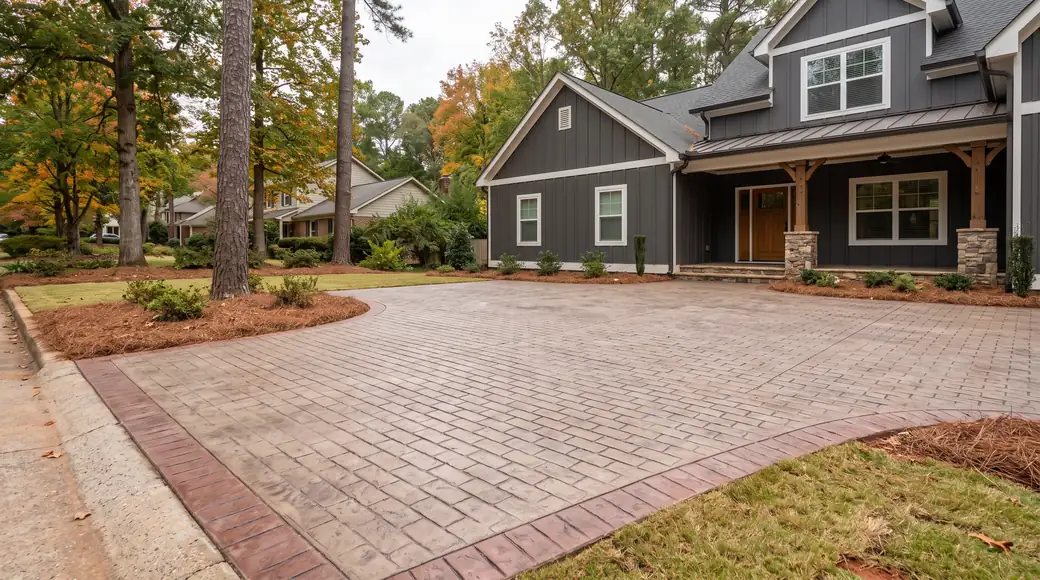
Stamped concrete patio in a running-bond brick pattern at a charcoal farmhouse-modern home in Marietta, GA, under an overcast sky.

Stamped Concrete Patterns in Roswell, Georgia

Stamped concrete is a poured slab that gets a pattern pressed into it while the surface is still soft. The mats carry a texture, usually stone, brick, slate or wood plank, and the color goes in two stages: a color worked through the body of the mix or broadcast across the top, then a release that shades the low spots. What you end up with is one continuous piece of concrete that reads as tile or cut stone from a few feet away. It wears like a slab, because that is what it is.

Timing decides the whole job. Press too early and the mats sink and drag, and press too late and the pattern comes out shallow, so the texture all but disappears once a sealer goes over it. We stamp in a working line across the slab, tamping each mat as it seats, and we keep somebody on the edges and the tight spots against the house, where the mats will not reach and the detail has to be cut in by hand. That window is short, and it does not reopen.

Most complaints about stamped work trace back to two things: color that dried blotchy, and cracks running straight through the pattern. Blotching is usually moisture, either a slab sealed before it was ready or a subgrade pushing water up from underneath. Cracks are more often a base problem than a concrete problem. Concrete moves. The question is never whether a slab will crack, but whether the control joints sit where the crack was already going to go, so it opens somewhere you planned for.

Getting a good result is mostly what happens before the truck shows up. Grade and compact the base, set forms to a slope that carries water away from the structure, run rebar or wire mesh sized to what the slab will hold, and cut joints on a spacing that matches the thickness. Sealer is maintenance, not a one-time finish. On a patio it comes back around every couple of years, sooner on a surface taking full sun and daily traffic. Skip that and the color dulls faster than the concrete wears.

We are a concrete contractor working out of Marietta, and Roswell jobs are a normal part of our week. Patios, walkways, front entries, pool decks, and stamped borders set against a plain concrete sidewalk to give a flat run something to look at. Permits are handled through the City of Marietta on work inside the city, and that paperwork is ours to sort out, not the homeowner's. An estimate means walking the space, looking at how water leaves the yard, and talking through patterns that suit the house. Call for a free estimate.

Call +1 470-666-7021

Licensed, Bonded, and Insured ยท A combined 15 years of experience

Get Free Estimates

We warranty all of our work because we believe in what we do.

What Roswell Calls Us For

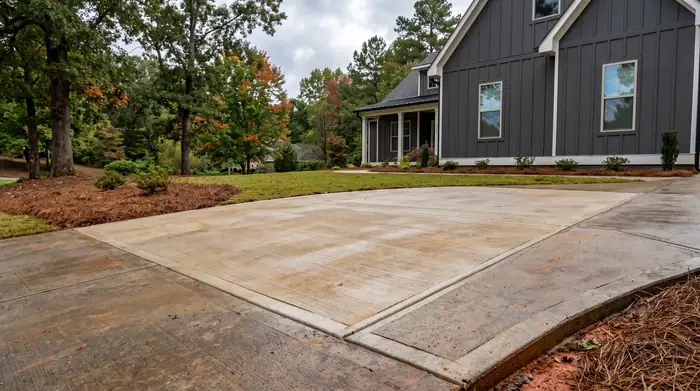
Replaced concrete driveway panel with clean saw-cut edges at a charcoal farmhouse-modern home in Marietta, GA, after a rain shower.

Repair, Leveling & Resurfacing

Most repair calls start with a slab that has settled at a joint, so one panel sits high and the edge catches a toe. We cut out the failed section and pour back to full depth rather than skimming over it. Resurfacing works when the slab underneath is sound and the damage is surface scaling. It does not work over active cracking, and a concrete contractor who tells you otherwise is selling you a coat of material that will delaminate.

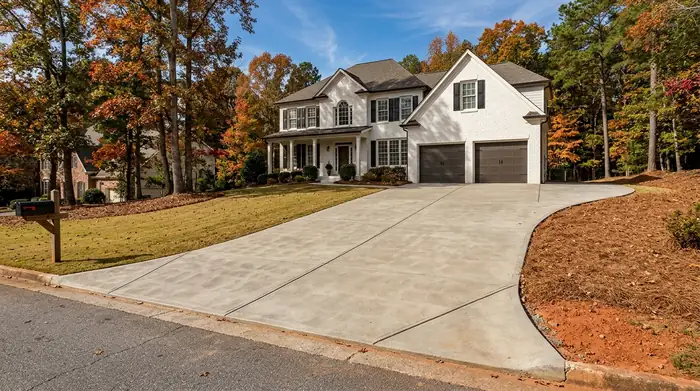
Broom-finished concrete driveway running up to a two-car garage at a painted-white-brick two-story home in Marietta, GA, in clear late-morning sun.

Driveway Installation & Replacement

A concrete driveway takes four inches of concrete over a compacted base, thickened to five or six where a truck turns or parks. We set rebar or wire mesh depending on the pour, and we cut control joints early so the slab cracks where we put the line instead of across the middle. Old driveways usually fail at the apron and the edges first. Replacement means removing the whole thing, not pouring over it.

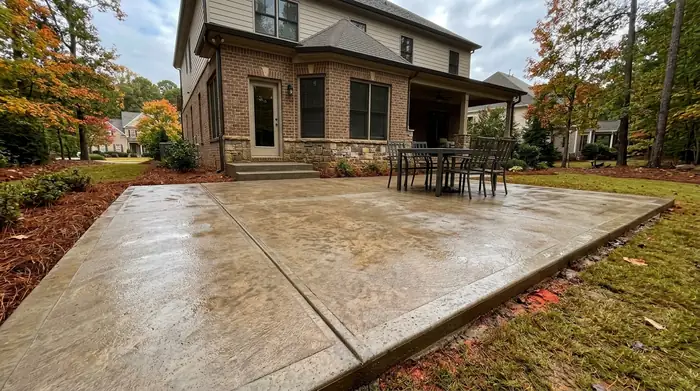
Rectangular concrete patio with a low step up to the rear door at a brick-and-siding two-story home in Marietta, GA, after a rain shower.

Patio Construction & Outdoor Living

Patios are where stamped concrete earns its keep: pattern and color go in while the slab is still plastic, then it gets a cure and a sealer. Ashlar slate, seamless texture and running bond all read differently at full size than on a sample board, so we lay out the pattern on site. Exposed aggregate and broom finishes hold up the same way underneath. Drainage away from the house matters more than the finish does.

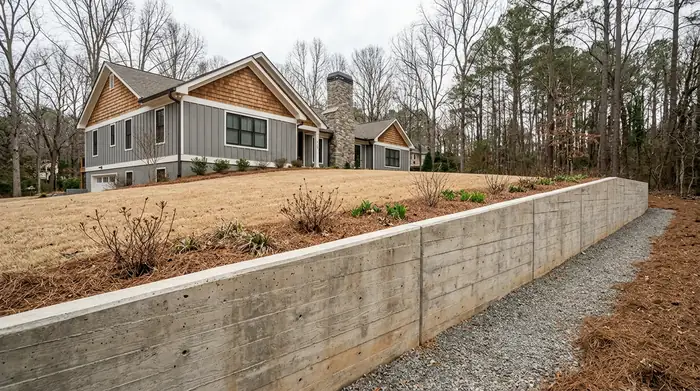
Board-formed concrete retaining wall holding a raised lawn at a grey split-level home in Marietta, GA, under an overcast sky.

Retaining Wall Construction

Walls fail from water, almost every time. We build on a compacted footing below grade, backfill with clean stone, and run drain pipe behind the wall so hydrostatic pressure has somewhere to go. Block walls get geogrid tied back into the slope at the heights that call for it. Poured concrete walls get rebar mats and proper form ties. Height, soil load and what sits above the wall decide which one we use.

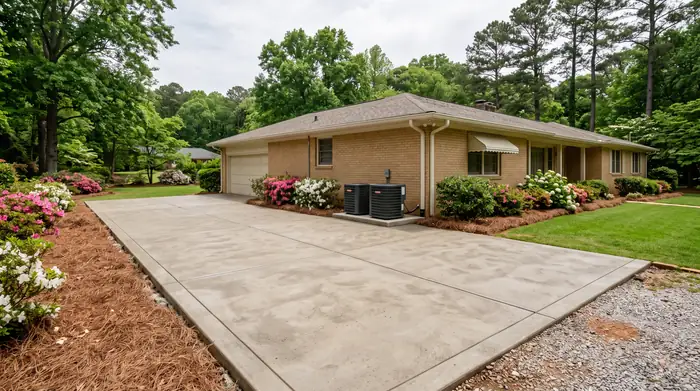
Square-edged concrete slab pad with a storage shed on it at a buff-brick ranch home in Marietta, GA, under bright midday cloud.

Concrete Slabs & Pads

Slabs and pads cover garage floors, shed foundations, sidewalk landings, dumpster pads and equipment bases. Thickness follows the load: four inches for foot traffic, six or more where a vehicle or a dumpster truck sits. We compact the subgrade, set vapor barrier where the slab is under a roof, and place reinforcement on chairs so it ends up in the middle of the pour instead of on the ground. Commercial concrete work around retail frontage gets scheduled around business hours. A concrete sidewalk section tied into a pad is poured with an isolation joint between them so they move independently.

What to Expect on a Roswell Concrete Job

Every job starts with a walk of the site. We measure the area, check how water currently moves across it, and look at where the new work meets what is already there: a door threshold, a garage apron, an existing concrete driveway. We ask what you want the space to do. Then we talk through patterns and color outside, in daylight, on the ground, because a stamped sample reads differently next to your house than it does on a screen. That walk sets everything after it.

Layout comes next. We mark the shape with paint and string, get your eyes on it before anything is dug, and adjust while the change is still just a line on the grass. Excavation follows the mark. Sod, roots and soft material come out, the subgrade is brought to a consistent depth, and it gets compacted. Base stone goes down and gets compacted too. Forms are set to the finished grade with fall built in, so water leaves the slab instead of sitting on it.

Steel goes in before any concrete does. Whether that is rebar or wire mesh depends on the slab: what it carries, how thick it runs, how the sections are laid out. A patio and a driveway are not the same problem, and treating them the same is how you end up with a repair. We chair the steel up off the base so it ends up inside the pour rather than pressed against the stone underneath, which is where reinforcement quietly ends up when nobody watches the placement.

Pour day runs on a clock. Once the first truck starts, the concrete installation has a working window, and stamping has a shorter window inside that one. We load out of Marietta early so forms, steel and hands are all set before the mixer shows up. Enough people are on site to place, screed and float the whole area without stalling anywhere. If rain arrives before we have the finish we want we cover it, and if the forecast looks bad the day before, we move.

Stamping begins when the slab firms up to the right point, which is a judgment call, not a set time. Color goes in the mix or gets cast onto the surface. Release powder keeps the mats clean and drops a second tone into the low points of the texture. We set mats in sequence, tamp them evenly, and keep the pattern running true across the full surface. Borders, edges and anywhere a mat cannot sit flat get detailed by hand.

Control joints get cut once the surface is hard enough to hold a clean edge. Concrete cracks. Joints decide where it happens. We place them to follow the pattern and the shape of the slab, so the lines read as part of the design rather than damage running through it. Curing takes days, and we tell you when the surface is ready to walk on and when it will take a vehicle. Sealer goes on later, after the slab has dried out.

Most failures trace back to something that happened before the truck ever arrived. Base that was not compacted settles, and the slab follows it down. Joints cut too late or spaced too wide let cracks wander wherever they want. Thin sections under a concrete driveway break under weight they were never built to carry. Patterns come out crooked when a short crew is racing the set. None of that gets corrected afterward without breaking concrete out and starting the area over.

Cleanup is part of the work, not a favor at the end of it. We haul off the spoil, pull the forms, wash out where washout belongs, and leave the grass and beds around the pour in a condition you can plant back into. Before anything is called finished, we walk the completed surface with you in daylight and go through what the first few weeks look like. Call for a free estimate on stamped flatwork, patios, sidewalks and driveways.
What Roswell Owners Ask Us

Is there a minimum job size for Roswell?

No. We pour small slabs and we pour large ones. A short stamped landing at a side door is a real job, and we treat it like one. Smaller pours still need the same base prep, the same wire mesh or rebar where the slab calls for it, and the same attention to how water leaves the surface. Call and describe what you have in mind.

How many jobs has Marietta Professional Concrete done around Roswell?

We are not going to put a number on it, because any figure we gave you would be one you could not check. What we can tell you is how we work: what the base under your patio gets, how the stamp pattern lines up with the house, and how the finished slab drains. Ask us those questions instead. Those answers hold up.

What is the ground like in Roswell, and does it change how you build?

The ground varies lot to lot, and we would rather look at yours than describe it from a desk. What sits under a stamped patio matters more than most people expect. We check what we are building on, compact it properly, and set the slab thickness and reinforcement to suit what we find. If a spot needs more base than the rest, it gets more base.

Who do I speak to about a Roswell job specifically?

You speak to us directly. Marietta Professional Concrete is a concrete contractor working Marietta, Smyrna, Kennesaw, Roswell and across metro Atlanta into Atlanta itself, and Roswell work is handled by the same people who handle the rest. No call center, no handoff to a stranger. The person who walks your patio is the person who talks through pattern and color with you.

Do you work on older properties in Roswell?

Yes. Housing here runs a wide range of ages, and older homes bring their own conditions: settled walkways, additions poured at different times, existing flatwork that has to tie into something new. Stamped concrete can sit well next to an older house when the pattern and color are chosen with the house in mind rather than out of a catalog. We will talk that through on site.

Get a Free Estimate

Get Free Estimates

We warranty all of our work because we believe in what we do.

Tap to call +1 470-666-7021